
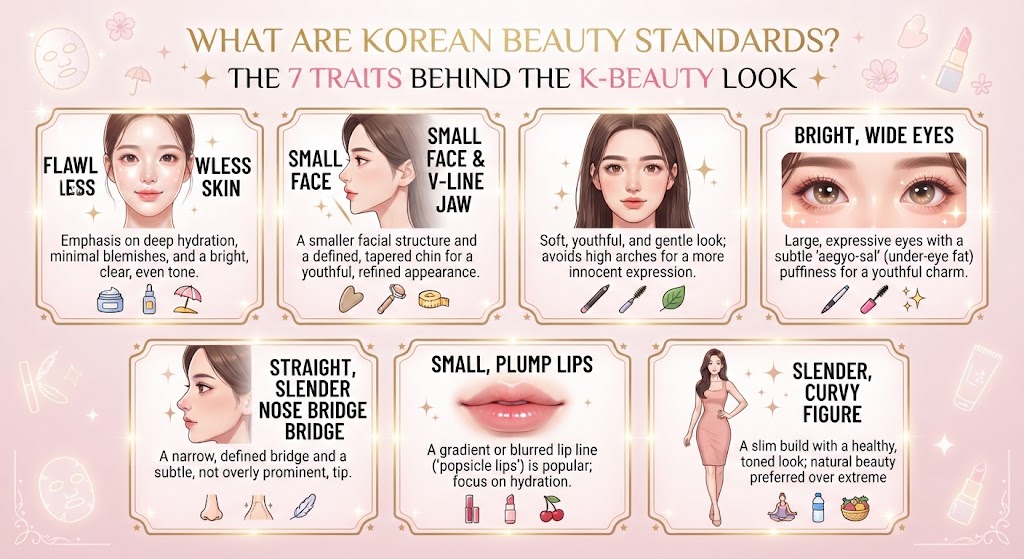
If you’ve spent any time on TikTok or Instagram over the past few years, you’ve probably seen the term “K-beauty standards” used to describe a very specific, very recognizable look: a small, tapered jaw, luminous skin, and large, symmetrical eyes. Popularized by K-pop idols and Korean skincare culture, these standards have become one of the most influential beauty ideals in the world — for better and for worse.
Where Do Korean Beauty Standards Come From?
Korean beauty ideals aren’t new — Joseon-era portraiture already prized fair skin, dark hair, and a soft, rounded face centuries ago. What’s changed is the scale and speed at which these standards now spread. The global rise of K-pop, Korean dramas, and the K-beauty skincare industry over the past two decades has turned a regional aesthetic into a worldwide reference point, discussed, debated, and imitated across the U.S., Southeast Asia, and beyond.
1. The V-Line Jaw
Perhaps the single most talked-about trait, the “V-line” refers to a jaw that tapers smoothly from the ears down to a narrow, soft point at the chin, forming the shape of the letter V rather than a square or rounded jawline. It’s considered one of the clearest markers of the K-beauty look, and it’s also one of the most common reasons people cite for seeking jaw-contouring cosmetic procedures in South Korea.
2. Glass Skin
“Glass skin” describes a complexion so smooth, hydrated, and even in tone that it appears to reflect light almost like glass — no visible pores, no patchiness, just a uniform, dewy glow. It’s less about makeup and more about skincare routine: the multi-step Korean skincare regimen (often 7-plus steps, heavy on hydration and gentle exfoliation) was built specifically to achieve this look, and it’s arguably K-beauty’s biggest global export, even more than the jawline itself.
3. Aegyo-Sal and Eye Aesthetics
Large, symmetrical eyes with a well-defined double eyelid crease are a core part of the K-beauty ideal — but the detail that surprises most people outside Korea is aegyo-sal, the small band of fullness directly under the eye. Far from being seen as a flaw or sign of tiredness (as under-eye puffiness often is in Western beauty culture), aegyo-sal is specifically prized because it makes the eyes look brighter, younger, and more approachable.
4. A High, Straight Nose Bridge
A straight, moderately high nose bridge is considered a marker of balance and elegance in K-beauty, without tipping into the more dramatically sculpted noses sometimes favored in other beauty cultures. The goal is subtlety: a nose that brings the face into proportion rather than one that draws attention to itself.
5. The “Small Face” Ideal
Relative to body size, a smaller, more delicate-looking face is highly valued in Korean beauty culture — a trait often described locally as looking “V-line and small-faced.” It’s part of why facial proportion, not just individual features, plays such a central role in how K-beauty is measured and discussed.
6. The K-Beauty Golden Ratio
Borrowing from the mathematical golden ratio (1.618) long used in classical art and architecture, K-beauty culture applies its own version to facial proportion — comparing measurements like facial width-to-height, and the spacing between eyes, nose, and jawline, against this idealized ratio. It’s the same principle Western beauty science has used for decades (think classic “beauty is symmetry” research), just applied through a distinctly Korean aesthetic lens.
7. Natural, Full Lips
Rounder out the look: soft, naturally full lips with a subtle, gradient “cherry lip” tint — favored over the more dramatically overlined or heavily contoured lip trends popular elsewhere. The emphasis stays on looking naturally youthful rather than obviously done.
A Quick Note on Perspective
It’s worth saying clearly: beauty standards, Korean or otherwise, are cultural constructs that shift across time, place, and generation — not a fixed, objective scorecard for anyone’s worth. Korean beauty culture itself has been publicly grappling with this, with growing conversation inside Korea about embracing more diverse features rather than a single narrow ideal. Reading about K-beauty traits is genuinely interesting as cultural insight — just worth holding loosely, not as a verdict.
Curious Where You Land? Try the Free Test
If reading through these traits made you curious how your own features compare, purely out of curiosity, our Korean Beauty Standards Test uses computer vision to analyze a photo against the specific K-beauty criteria above: V-line jawline taper, glass skin luminosity, eye aesthetics (including aegyo-sal), nose bridge shape, facial width-to-height ratio, and the K-beauty golden ratio match.
A few honest notes before you try it:
- It’s free and unlimited — test as many photos as you like.
- Your result depends heavily on photo quality: natural daylight, a frontal angle at eye level, a neutral expression, and hair pulled back off the jawline all give the most accurate reading.
- It’s built for fun and cultural curiosity, not as a judgment — as the section above makes clear, beauty standards are a moving target, not a fixed truth.
👉 Give it a try at lochness-paris.com/korean-beauty-standards-test.