Loch Ness · VERIFIED OR VIBES? · Symbol guide
By Camille G., founder of Loch Ness · Published 2026-09-27 · Last updated 2026-09-27
Yin yang bracelets are usually sold as an “ancient Taoist symbol” of balance, sometimes of divination. The idea of yin and yang is ancient. The black-and-white swirl is not: in its familiar form, it is about six hundred years old. We checked the history, and what two of our own bracelets actually carry.
For the rest of our collection, see our guide to carved wood bead bracelets.
The claim: “An ancient Taoist symbol”
The concept of yin and yang dates back to Chinese antiquity. Drawing it as a diagram was an 11th-century fashion of Neo-Confucian thinkers: the Song dynasty philosopher Zhou Dunyi (1017–1073) wrote the first description of a taiji diagram (HandWiki).
The swirl came later. Zhao Huiqian (1351–1395) introduced the first swirling version in the 1370s — combined with the eight trigrams. In the 16th century, Lai Zhide (1525–1604) simplified it into two interlocking spirals with a dot in each; the dots only became common in the Qing period (HandWiki; Wikipedia). Lai Zhide was a Neo-Confucian philosopher (Wikipedia), and the name “yin-yang symbol” only caught on in English from the 1960s (Wikipedia).
So: ancient idea, much younger picture, and not only Taoist — the diagrams were developed largely by Neo-Confucian scholars.
Verdict: 🟡 Partial — the concept is ancient; the symbol as we draw it dates from the Ming dynasty, and it isn’t exclusively Taoist.
The claim: “A symbol of divination”
The divination link runs through the bagua: eight trigrams of three broken (yin) or unbroken (yang) lines, related to the divination practice described in the I Ching (Wikipedia). The yin-yang swirl on its own is a diagram of a concept, not a divination tool. Paired with the trigrams, as in the earliest swirling version, the association makes sense.
Verdict: 🟡 Partial — true when the trigrams are there, not for the swirl alone.
Our two yin yang bracelets
| Bracelet | What’s carved | Verdict |
|---|---|---|
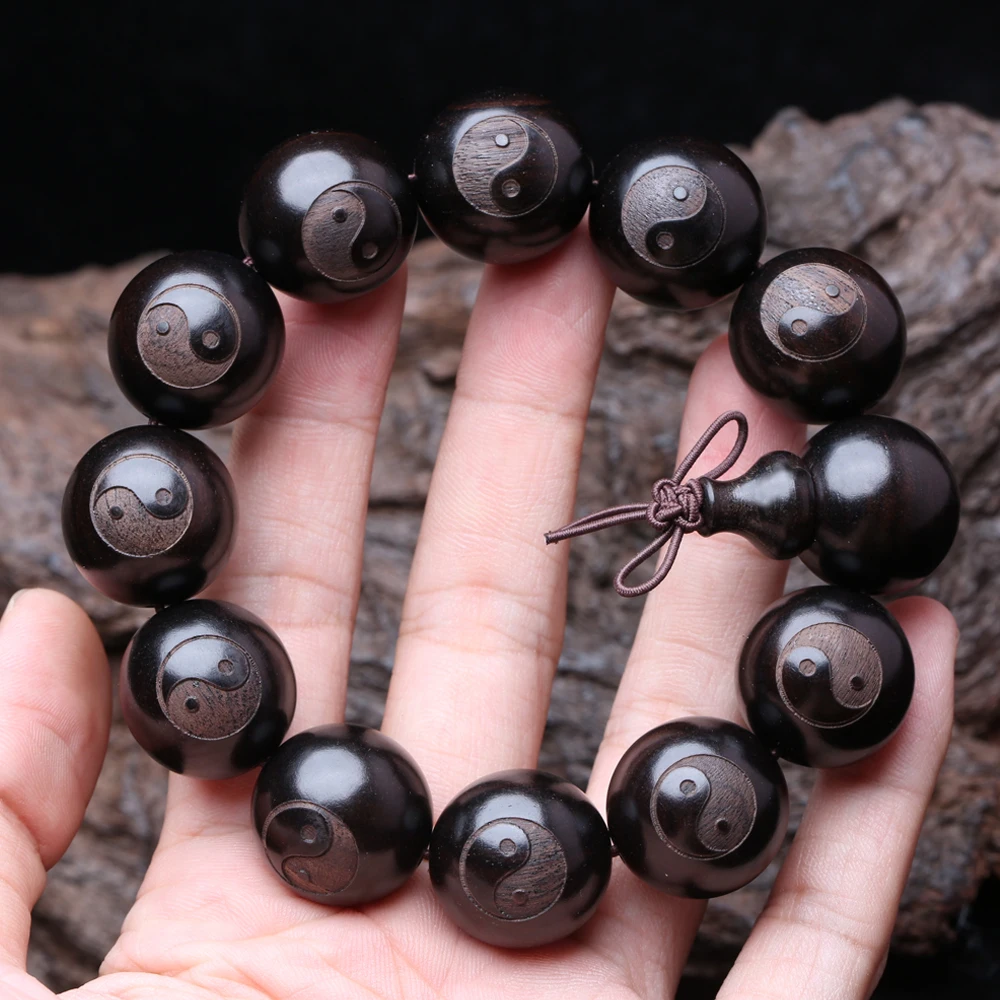
| Ebony Yin Yang Bracelet, 20 mm | Yin-yang on each bead, a gourd-shaped bead, no trigrams | 🟡 |
| Ebony “Turn the Situation Around” Bracelet, 20 mm | Yin-yang medallions surrounded by characters | 🟡 |
The ebony yin yang bracelet
The listing calls it a “symbol of philosophy, symbol of divination”. The photos show the swirl alone on polished beads, plus one gourd-shaped bead, a longevity and protection motif in Chinese art (see our Chinese lucky symbols guide). “Philosophy” holds. “Divination” doesn’t, since no trigrams are carved.
Verdict: 🟡 Partial — based on the listing photos; physical check pending.
“Turn the situation around”
This bracelet’s name is the idiom 扭转乾坤, “to turn heaven and earth around”, turned into a Year of the Ox pun by swapping 扭 niǔ for 牛 niú, “ox” (Language Log; ChinesePod). Qián 乾 and kūn 坤 are also the heaven and earth trigrams of the bagua (Wikipedia), so yin-yang medallions fit the idiom well. The characters around the medallions are not read yet.
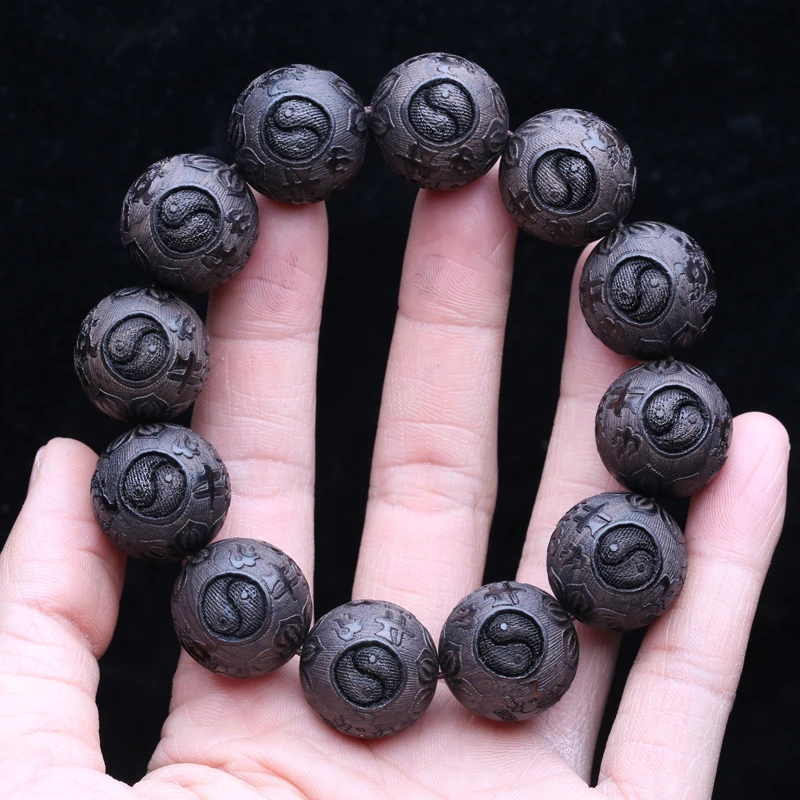
Verdict: 🟡 Partial — the idiom and pun are verified; the surrounding characters are unread.
How to read a yin yang carving
- Swirl alone → the taiji diagram: complementary opposites, not a divination sign.
- Swirl surrounded by eight groups of three lines → the bagua trigrams, tied to the I Ching.
- Dots inside each half → the later, Qing-era style of the symbol.
- Characters around it → a wish or an idiom; worth having them read.
Frequently asked questions
Is yin yang a Taoist symbol?
It is widely associated with Taoism, but the diagrams were developed largely by Neo-Confucian scholars, from Zhou Dunyi in the 11th century to Lai Zhide in the 16th (HandWiki; Wikipedia).
How old is the yin yang symbol?
The concept is ancient. The swirling symbol first appears in the 1370s, and its familiar form with two dots comes from the late Ming and Qing periods (HandWiki).
What does taiji mean?
Taiji, 太極, is usually rendered “supreme pole” or “supreme ultimate”; the yin yang symbol is a taiji diagram, taijitu (Wikipedia).
Help us close the open verdicts
If you read Chinese and can identify the characters around our yin-yang medallions, email contact@lochness-paris.com. We’ll update the verdict publicly and credit you.
Sources
- HandWiki — Taijitu
- Wikipedia — Taijitu
- Wikipedia — Lai Zhide
- Wikipedia — Taiji (philosophy)
- Wikipedia — Bagua
- Language Log — niú zhuǎn qiánkūn
- ChinesePod — dictionary entry 扭转
Update log
[À COMPLÉTER : date] — First publication. 2 verdicts partial.