How Many Ideas Can You Find in 90 Seconds?
Most creativity tests make you tick boxes rating how creative you think you are. This one makes you actually produce ideas — then measures your divergent thinking across 4 real dimensions, not one generic score.
- 1You'll see an everyday object.
- 2You have 90 seconds to find as many unusual uses for it as possible — the more unexpected, the better.
- 3At the end, you get your profile across 4 dimensions: fluency, flexibility, originality, elaboration.
Your ideas are collected anonymously (no email, no personal data) and may appear on our creative uses pages after review.
Your ideas
Keep your creative mind sharp
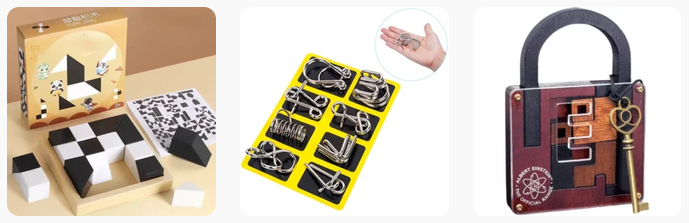
Pattern blocks, wire puzzles and wooden lock puzzles: hands-on brain teasers that invite you to look for new solutions.
Discover Montessori puzzle gamesWhy most creativity tests measure the wrong thing
Search for "creativity test" and you'll find dozens of near-identical pages: a list of statements like "I often come up with original ideas," a 5-point agreement scale, and a score at the end. These are self-report questionnaires — and what they actually measure is how creative you believe you are, which correlates weakly at best with how creative you actually think under pressure.
The exercise above is built on a different, older idea from creativity research: the alternative uses task, developed by psychologist J.P. Guilford in the 1960s as part of his work on divergent thinking. Instead of asking you to rate yourself, it asks you to do the thing — generate as many unusual uses as possible for an ordinary object, under time pressure. It's a direct measurement of the cognitive process, not a survey about your self-image.
The four dimensions that actually make up divergent thinking
Guilford's original framework, later refined by researchers including E. Paul Torrance, breaks divergent thinking into four measurable components. Almost every "creativity test" online collapses all four into one number. This one keeps them separate, because they don't move together — someone can produce twenty ideas that are all variations on the same theme (high fluency, low flexibility), or three ideas nobody else would think of (low fluency, high originality).
Fluency
Raw idea output. The most basic measure — simply, how many valid ideas you generated in the time given.
Flexibility
Category-switching. Ten ideas about throwing the object are one category; ten ideas spanning building, art, and tools are five.
Originality
Statistical rarity. How far your answers sit from the handful of uses almost everyone lists first.
Elaboration
Depth of development. A one-word answer and a fully described scenario score very differently here.
Can you actually get better at this, or is creativity fixed?
The research on divergent thinking training is more encouraging than the popular idea that creativity is a fixed trait you either have or don't. Structured practice — deliberately generating a high volume of ideas, deferring judgment until after the generation phase, and using techniques like forced association or SCAMPER — has been shown to measurably improve fluency and flexibility scores with repeated practice. Originality and elaboration tend to move more slowly, since they depend more on breadth of knowledge and willingness to take a chance on an unusual answer, but they aren't immovable either.
This is also the entire premise behind treating a low score here as a starting point rather than a verdict: divergent thinking, unlike most things labeled "aptitude," responds to the same kind of practice that improves a physical skill.
FAQ
Is this creativity test scientifically validated?
It's inspired by the alternative uses task, a well-established paradigm in creativity research. It isn't a clinically validated psychometric instrument like the full Torrance Tests of Creative Thinking, but an accessible exercise built on the same underlying principle: measure divergent thinking by having people generate ideas, not by asking them to rate themselves.
What's a "good" score on this test?
There's no universal cutoff — this is an informal, self-comparison tool, not a clinical diagnostic. What matters more than the number itself is which of the four dimensions is your strongest and which has the most room to grow.
Why does this test use an object instead of a questionnaire?
Self-report questionnaires mostly measure confidence, not creative output. Generating ideas under time pressure measures the actual cognitive process directly.
Can I retake it with a different object?
Yes — click "Try again with a new object" after your results to get a new random object and a fresh 90-second round.