
By Camille G., founder of Loch Ness · Reading time ≈ 5 min
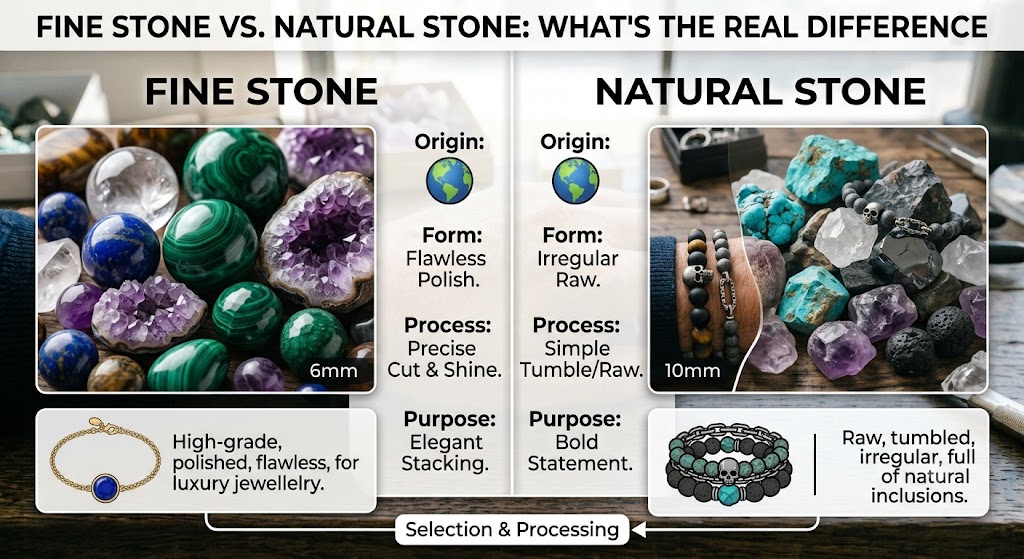
“Fine stone,” “natural stone,” “semi-precious stone” — in casual conversation these terms get used almost interchangeably. In practice, only two of them mean the same thing, and one of them is, in France, not legally allowed to be used in commercial sales at all. Here’s the distinction that actually matters when you’re buying.
1. The legal category: precious vs. fine
Since a French decree issued on January 14, 2002, jewelry terminology in France recognizes exactly two official categories of natural gemstone:
- Precious stone — reserved exclusively for four gems: diamond, ruby, sapphire, and emerald. No other stone, regardless of its rarity or price, can legally be called “precious” in a commercial context in France.
- Fine stone — every other natural gemstone used in jewelry: amethyst, garnet, tourmaline, topaz, labradorite, rose quartz, and dozens more.
The same 2002 decree explicitly banned the term “semi-precious,” which had previously been used for this second group. The reasoning: “semi-precious” implied a false hierarchy of value, as if these stones were somehow second-tier — a claim their rarity and market price regularly contradict. An amethyst or a fine tourmaline can, in some grades, be worth more than a lower-grade diamond.
2. “Natural” describes origin, not category
This is where confusion usually creeps in. “Natural” isn’t a rank between “precious” and “fine” — it’s a separate axis entirely, describing where the stone came from:
- Natural: formed by geological processes, mined from the earth, with no human alteration to its chemical structure.
- Synthetic: lab-grown, with the same chemical composition as its natural counterpart, but produced by humans in a controlled environment.
- Imitation: a different material entirely (glass, resin, dyed plastic) made to visually resemble a gemstone, with none of its actual mineral properties.
So a stone can be, at the same time, “natural” (origin) and “fine” (legal category) — that’s the combination that matters for anything sold as genuine gemstone jewelry. French law is strict on this point too: using words like “fine,” “natural,” “genuine,” or “precious” for a reconstituted, synthetic, or imitation stone is explicitly prohibited.
3. How to spot the real thing
A few practical signs separate genuine natural fine stones from imitations:
- Micro-inclusions: a natural stone almost always shows tiny internal inclusions visible under 10x magnification — these are a sign of authenticity, not a flaw. A stone that looks “too perfect” at a very low price is a red flag.
- Weight and cold touch: natural minerals tend to feel denser and cooler to the touch than glass or resin imitations.
- Color consistency: natural stones show subtle, irregular color variation bead to bead; dyed imitations often look unnaturally uniform.
- Traceability: a serious seller can tell you where the stone was sourced. Vague or evasive answers are a warning sign.
4. Why this matters when you’re building a bracelet
Every stone available in our configurator is a genuine, natural fine stone — sourced as rough gemstone material and hand-assembled only once your design is confirmed, rather than pulled from a pre-made, mass-produced stock. You can explore each stone’s specific properties in our gallery of past creations, or read about the energetic side of stone selection in our lithotherapy scoring guide.
Build your bracelet from genuine fine stones
Every gem in our configurator is rendered true to its real color, cut, and texture — what you design is exactly what you receive.
Sources: French decree n°2002-65 of January 14, 2002, on the use of the terms “precious stone” and “fine stone” in commercial transactions · Gemological Institute of America (GIA), Gem Encyclopedia

Leave a Reply