
By Camille G., founder of Loch Ness · Reading time ≈ 4 min
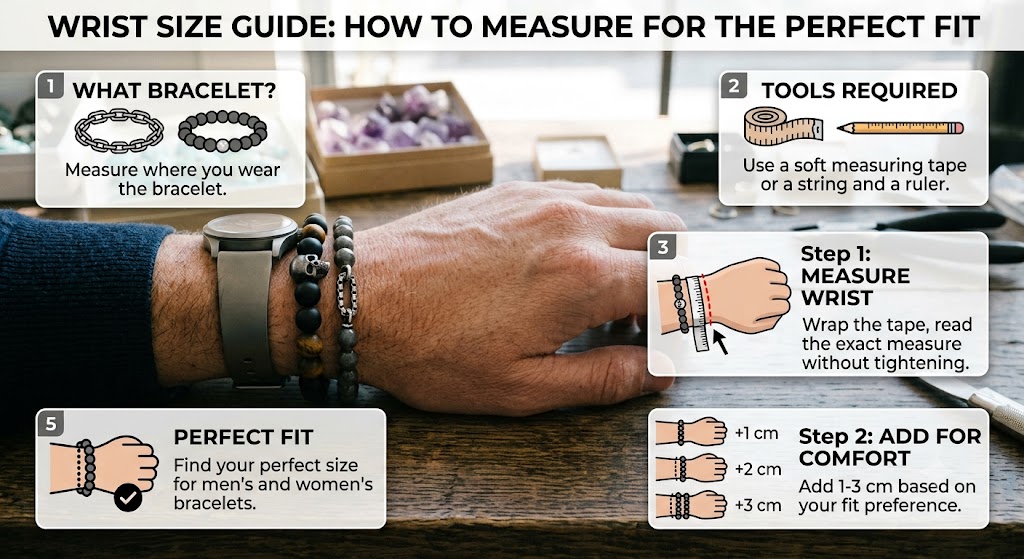
The single most common reason a beautiful bracelet ends up in a drawer isn’t the design — it’s the fit. Too loose, and it spins around and catches on everything. Too tight, and it’s uncomfortable within an hour. Measuring your wrist correctly takes less than a minute, and it’s the one step worth never skipping.
1. How to measure your wrist
- Wrap a flexible tailor’s measuring tape (or a piece of string, then measured against a ruler) around your wrist, right where you’d normally wear a bracelet — just past the wrist bone.
- Keep it snug but not tight: you should be able to slide one finger underneath.
- Note the measurement in centimeters, rounding up to the nearest half-centimeter.
2. Average wrist sizes, for reference
There’s no single “standard” wrist — it varies by build, not just gender — but these ranges, drawn from jewelry sizing data, give a useful starting point:
| Profile | Typical wrist size |
|---|---|
| Women | 13 – 18 cm |
| Men | 15 – 20 cm |
| Teenagers | 14 – 17 cm |
| Children | 13 – 15 cm |
If your own measurement falls outside these ranges, that’s completely normal — wrist size correlates loosely with height and build, but individual variation is significant. There’s no “wrong” size.
3. Wrist measurement isn’t your final bracelet size
This is the step most people miss: your wrist measurement is your starting point, not the length to order. How much you add depends on how you like a bracelet to sit:
- Close to the wrist: add 1 to 1.5 cm to your measurement.
- Standard, comfortable fit: add 1.5 to 2 cm.
- Loose, relaxed fit: add 2 to 3 cm.
Men more often lean toward the looser end of that range; women more often toward a closer fit — but it’s entirely a matter of personal preference, not a rule.
4. A quick note on rigid bracelets (bangles)
Everything above applies to flexible, beaded, or corded bracelets. If you’re choosing a rigid bangle instead, wrist circumference alone isn’t enough — the bangle also needs to slide over your hand, so the widest part of your hand matters just as much as your wrist.
Now that you know your size, design your bracelet
Enter your measurement, choose your stones, and see your bracelet built to your exact fit in real time.
Sources: jewelry sizing data compiled from multiple French jewelry workshops’ published measurement guides, cross-referenced for consistency.

Leave a Reply