
Loch Ness · Journal
By Camille G., founder of Loch Ness · Published July 8, 2026 · Read time ≈ 6 min
About the author
Camille G. has been creating handcrafted and symbolic jewelry since 2013. A full-stack developer, she designs and codes the composer presented here herself, with several contributions to open source projects to her credit. This dual perspective — artisanal and technical — allows her to master both the customer experience and the solution that powers it. Researcher and craftsperson, she publishes her work under the ORCID identifier 0009-0009-0364-6396. This article draws on both this hands-on experience and published studies, cited at the end of the page.
Offering a customer the chance to compose their own bracelet, bead by bead, isn’t just a nice idea: it’s a direct answer to what online shoppers expect from a jewelry store today. Here’s why a bracelet configurator makes sense for a jewelry brand, what industry data shows, and how to set it up without a single line of code.
1. Personalization is now an expectation, not an extra
A landmark McKinsey study (conducted with over 25,000 consumers across 21 countries) is unambiguous: roughly seven out of ten buyers now expect personalized interactions, and three out of four are frustrated when they don’t get them. Done well, personalization can increase revenue by 5 to 15% and improve marketing ROI by 10 to 30%.
This finding aligns with older but still-cited data: according to Epsilon, 80% of consumers say they are more likely to buy from a brand that offers a personalized experience. And when it comes to real money, a 2024 Medallia study puts the share of consumers willing to spend more with a brand offering a tailored experience at 61%.
2. The self-composed bracelet: from expectation to purchase
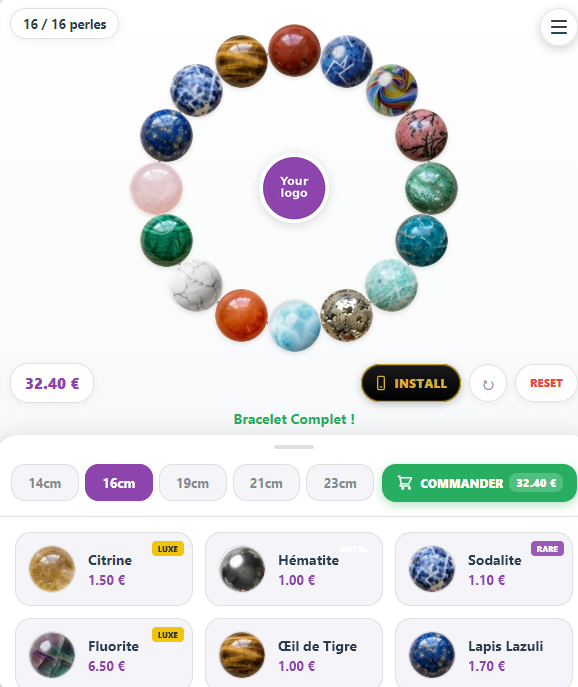
A configurator turns this abstract expectation into a concrete, engaging moment. The customer doesn’t simply browse a catalog: they create their piece, choose their stones, see the price update in real time. In doing so, they’re already picturing the bracelet on their wrist — a powerful driver of purchase decisions.
Personalized jewelry is exactly one of the domains where this mechanism works best: it’s a purchase loaded with meaning (a life milestone, a gift, an intention), where the uniqueness of the piece has real emotional value. Deloitte Digital observes that brands making personalization a central pillar of their experience significantly outpace competitors, and the number of brands adopting this approach has grown by roughly 50% since 2022.
In practice. With our own bracelets, letting the customer arrange their beads changes the conversation: you’re no longer selling a finished product, you’re accompanying them in a creation. It’s also what justifies, in the customer’s eyes, a higher cart value.
3. An installable app (PWA), not just a gimmick
The composer is a PWA: a web app that customers can install on their home screen, that loads fast and works even on average connections. This isn’t a minor technical detail — case studies published by Google (web.dev) show the commercial impact of this format.
JD.ID measured roughly a 53% increase in mobile conversion rate after switching to PWA (and up to +200% for users who installed the app). Rakuten 24 reports, for PWA users, doubled conversion rates and multiplied customer retention. Alibaba, for its part, reported conversions increased by around 76% after adopting the format.
To be honest: these figures come from large retailers in various contexts. They’re not a guarantee, but they illustrate a well-documented trend — a fast, installable journey converts better.
4. Branded just for you, with no coding
The tool comes white-label: it carries your name, your colors, and your logo, on your own web address. Your customers see only your brand, from composition through order confirmation email. You have neither a server to manage nor apps to develop for iOS and Android — one web tool covers all devices, which avoids the cost and overhead of separate native applications.
Concretely, setup takes three steps on your end: point a subdomain to our server, create an order-receipt key, and send us your visual identity. We handle the rest, including HTTPS security, essential for an installable app.
Want to see the composer in your colors?
Try the demo, or get in touch. We guide you at every step.
Sources
1. McKinsey & Company, The value of getting personalization right—or wrong—is multiplying (Next in Personalization, 2021) — survey of 25,000+ consumers across 21 countries.
2. Epsilon, The Power of Me: The Impact of Personalization on Marketing Performance (2018).
3. Medallia, Understanding Personalization Efforts in the Hotel and Retail Industries (2024) — medallia.com
4. Deloitte Digital, Personalizing growth (2024) — deloittedigital.com
5. Google (web.dev), case study Rakuten 24 — web.dev/case-studies/rakuten-24
6. Google (web.dev), Progressive Web Apps (case studies JD.ID, Alibaba) — web.dev/learn/pwa
Article written by Loch Ness. The data cited belongs to their respective authors and is reproduced for informational purposes, with links to the original source.


Leave a Reply