
Loch Ness · JOURNAL
By Camille G., founder of Loch Ness · Published September 14, 2026 · Read time ≈ 7 min
Search “prayer wheel bracelet” and you’ll find two completely different objects wearing the same name. Search “ebony mala bracelet” and you’ll find a third. An ebony bead carved with both a mantra and a prayer wheel motif borrows from all three traditions at once — which makes it worth asking, honestly, what it actually keeps from each one, and what it has to leave behind.
Two objects that got fused into one
A mala is a counting tool: 108 plain beads, usually sandalwood, bodhi seed or ebony, strung so a practitioner can track repetitions of a mantra spoken aloud, one bead per recitation. A prayer wheel is a different object entirely: a hollow cylinder mounted on an axis, containing a tightly wound paper scroll printed with a mantra, spun by hand. According to Britannica’s entry on the prayer wheel, each physical turn is considered equal in effect to speaking the mantra aloud — as many times as it’s printed on the scroll inside.
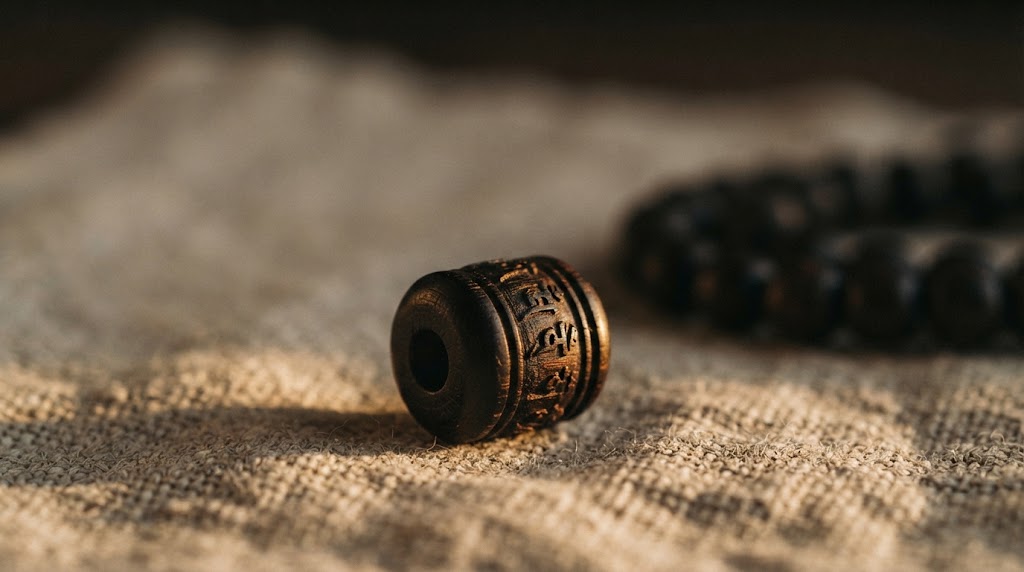
A bead carved with a prayer wheel motif is neither of these things. It doesn’t count recitations like a mala, and it doesn’t rotate a scroll like a prayer wheel. It’s an image of the second object, worn in the format of the first. That’s not a flaw to hide — but it is a distinction worth naming plainly, rather than letting the word “prayer wheel” imply a function the piece doesn’t perform.
In practice. If a listing shows still, carved beads and calls them a “prayer wheel bracelet,” what you’re buying is a mala-format piece decorated with prayer-wheel imagery — not a miniature version of the spinning object itself. Worth knowing before you buy, and worth saying plainly if you sell one.
What gets lost when the wheel stops spinning
The belief behind the prayer wheel is more specific than “spinning it is spiritual.” Research from the Rubin Museum’s Project Himalayan Art traces the practice to the idea that the repeated physical motion of turning literally “recites” the mantras sealed inside — releasing them outward for the benefit of others, not just the person turning the wheel. The action does the work that speech would otherwise do; it’s usually attributed to the Indian master Nagarjuna, who is said to have first set the Buddha’s teachings into motion this way instead of only speaking them.
That’s the exact mechanic a carved, static bead can’t reproduce. There’s no scroll inside, no motion, nothing released outward with each rotation, because there’s no rotation. What’s left is the image of the gesture rather than the gesture itself — which is a real thing to wear, but a different thing than the one it depicts. A bracelet can hold a mantra in view without performing the act that, in the original object, is precisely what activates it.
Why ebony, of all the woods available
Most mala beads are sandalwood or bodhi seed — light in color, light in weight, fragrant, and closely tied to specific lineages of practice. Ebony is the opposite on almost every axis: dense enough to sink in water, nearly black, cool and heavy against the skin, with none of the scent that usually signals “meditation bead” at a glance.
That’s the paradox worth sitting with rather than smoothing over: the material carries stillness and weight, while the motif carved into it represents perpetual motion. A wheel that can’t turn, carved into wood chosen for how solidly it stays put. Whether that reads as a contradiction or as a deliberate pairing — permanence holding a symbol of continuous release — depends entirely on how the piece is worn and understood, not on the wood itself.
What we chose to keep
Once the distinction is clear, the honest way to design a piece like this isn’t to pretend it’s a working prayer wheel shrunk down to bead size. It’s to be explicit about what it is: a mala-format bracelet, carved with the imagery and the mantra of a different, larger devotional object, in a material chosen for its weight and permanence rather than its resemblance to a monastery wheel.
Carving a real mantra onto a decorative object is also worth taking seriously rather than treating as pure ornament — it’s a sacred syllable to the people who use it in practice, not a pattern. The respectful version of this piece names the mantra, explains what it means and where it comes from, and lets the wearer decide what to do with that, instead of reducing it to an aesthetic motif with no context attached.
Sources
1. Encyclopaedia Britannica — Prayer wheel — britannica.com
2. Rubin Museum — Project Himalayan Art, “Prayer Wheel” — rubinmuseum.org
Article written by Camille G. for Loch Ness. The beliefs described are presented as they are held within Tibetan Buddhist tradition, not as claims made by Loch Ness.