

Loch Ness · VERIFIED OR VIBES? · Pillar guide
Most carved wood bead bracelets sold online as “Tibetan Buddhist” carry something else: a Chinese lucky motif, a yin-yang symbol, perhaps a mantra written in Chinese characters, or no motif at all. One may carry a mantra in an Indic script, as Tibetan Buddhist objects do. This guide goes through the 14 wood bracelets we sell, one by one: what is actually carved on each, what it means, and how sure we are.
We sell these bracelets, so we have every reason to make them sound more meaningful than they are. That is why every claim below is checked against outside sources — and why many entries still say “still investigating” instead of guessing. The photos are the listing photos of each bracelet; where they already show something, we say so.
How we checked
Same method as every Verified or Vibes? episode: we quote the claim exactly as the listing makes it, look at the physical carving, compare it with reference sources rather than memory, and only award a green badge when two independent sources agree. If a verdict changes, this page gets a dated note at the bottom — nothing is rewritten silently.
| Badge | Meaning |
|---|---|
| 🟢 Verified | The claim checks out against at least two independent sources. |
| 🟡 Partial | Part of the claim holds, part doesn’t or isn’t checked yet. |
| 🔴 Vibes only | The claim doesn’t hold up. |
| ⚪ Still investigating | Not settled yet. Reader input welcome. |
The 14 bracelets at a glance
| Bracelet | What’s carved | Verdict |
|---|---|---|
| Ebony Auspicious Cloud Bracelet, 15 mm | Scroll-like clouds, probably xiangyun | ⚪ |
| Ebony Lucky Character Bracelet, 15/18 mm | One character in a medallion | ⚪ |
| Ebony “Turn the Situation Around” Bracelet, 20 mm | Yin-yang medallions + characters | 🟡 |
| Multicolor Wood Mythical Animal Bracelet, 20 mm | Several motifs, incl. a cash coin | ⚪ |
| Ebony “Classic Book” Bracelet, 15/18 mm | Diamond Sutra text (our reading) | 🟡 |
| Ebony Feng Shui Amulet Bracelet, 20 mm | Indic-looking script | ⚪ |
| Ebony Carved Good Luck Bracelet, 20 mm | Dimpled texture, no motif | 🔴 |
| Ebony Om Mani Padme Hum Bracelet, 12 mm | Om mani padme hum | ⚪ |
| Ebony “Tibetan” Amulet Bracelet, 18/20 mm | Om mani padme hum in Chinese (our reading) | 🟡 |
| Ebony Prayer Wheel Bracelet, 20 mm | Prayer wheel | See episode |
| Black Wood “Ritual Tools” Bracelet, 12 beads | Unidentified ritual objects | ⚪ |
| Ebony Yin Yang Bracelet, 20 mm | Yin yang, no trigrams visible | 🟡 |
| Sandalwood Bead Bracelet, 15 mm | No carving; probably green sandalwood | 🟡 |
| Rosewood Bead Bracelet, 20 mm | No carving; gourd beads + pendant | ⚪ |
Chinese lucky motifs
Seven of our bracelets were filed here. On closer inspection, four carry Chinese lucky motifs and three don’t — they are covered below anyway, so you can compare. Chinese decorative art has a large vocabulary of auspicious motifs — clouds, characters, animals, visual puns — used on objects of every kind, not only religious ones (Gotheborg glossary of Chinese auspicious motifs). A lucky motif on a bead is not, by itself, evidence of a Buddhist object. How to read these motifs yourself: Chinese lucky symbols on bracelets.
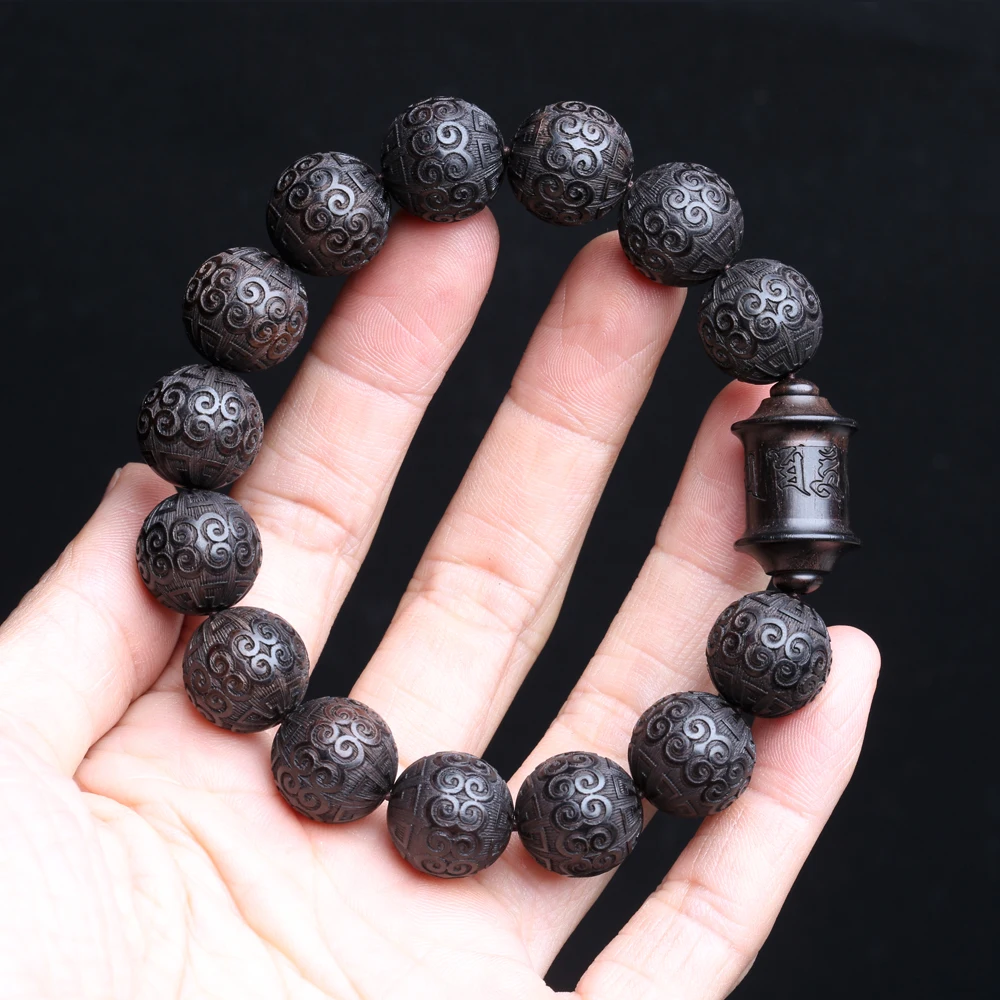
Auspicious clouds (xiangyun)
The listing says: “auspicious cloud beads, prayer beads, lucky decoration.”
What we found: xiangyun (祥云, “auspicious clouds”) are a real and well-documented motif: stylized clouds used as a decorative pattern in traditional Chinese art (Wikipedia). The name on the listing matches a genuine tradition.
What the photos show: scroll-like cloud shapes on every bead, which is what xiangyun look like, plus one cylindrical bead carved with characters.
What we can’t say yet: whether the carving matches reference xiangyun patterns closely, and what the characters on the cylinder say. And “prayer beads” — nothing in the design points to a prayer practice.
Verdict: ⚪ Still investigating — the motif is documented, our carving is not yet compared.
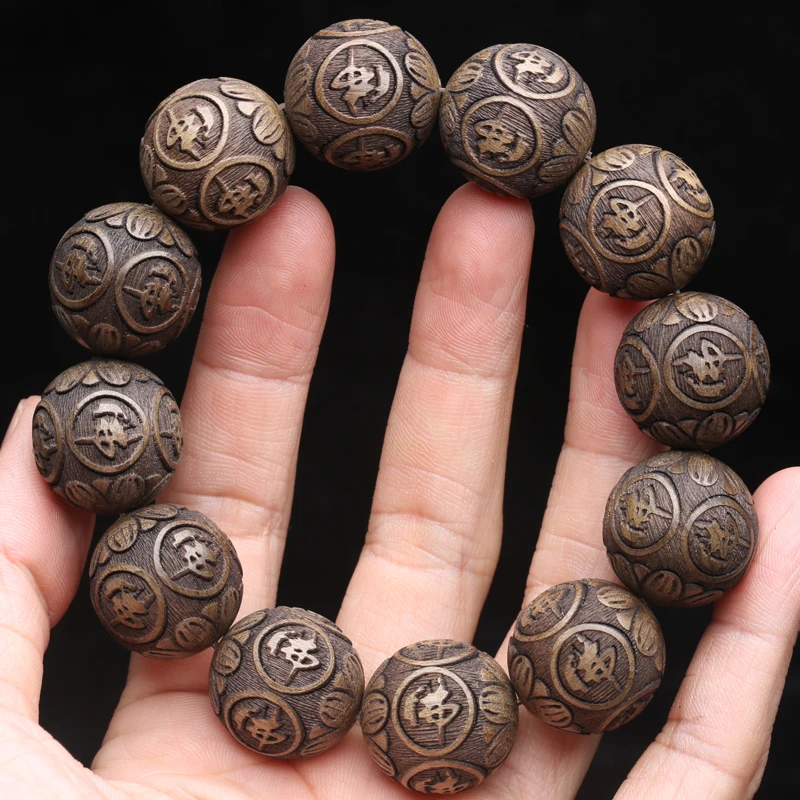
The lucky character medallion
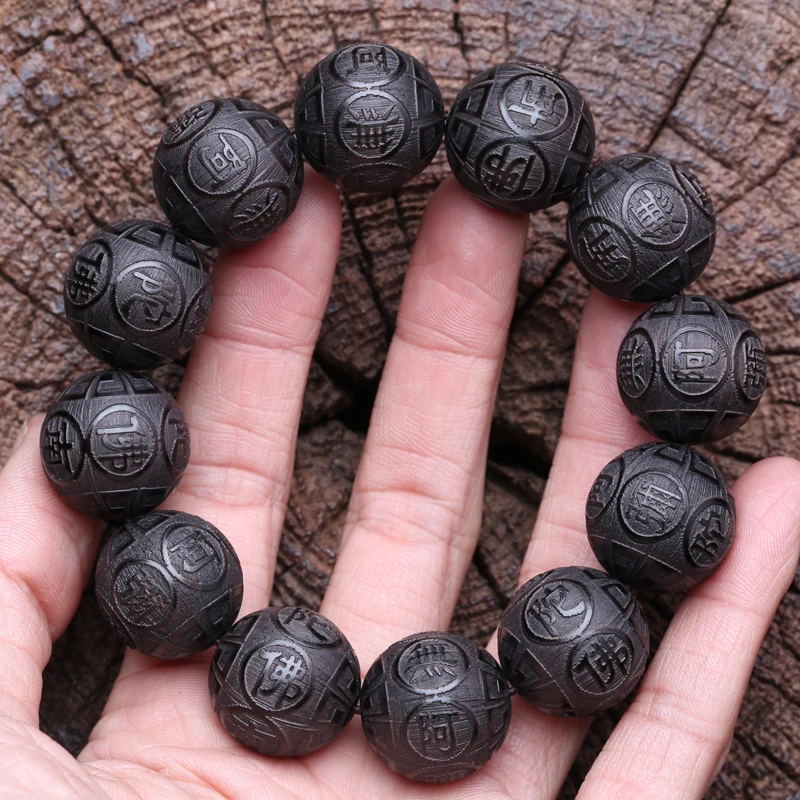
This is the bracelet we audited in episode 1. In short: the ebony is verified. “Tibetan” does not hold — a single character inside a round medallion is a Chinese decorative style, not Tibetan script. “Buddhist” is unverified. “Lucky” is plausible, but we still cannot read the exact character, so we are not naming it.
Verdict: ⚪ Still investigating — the character is not identified yet.
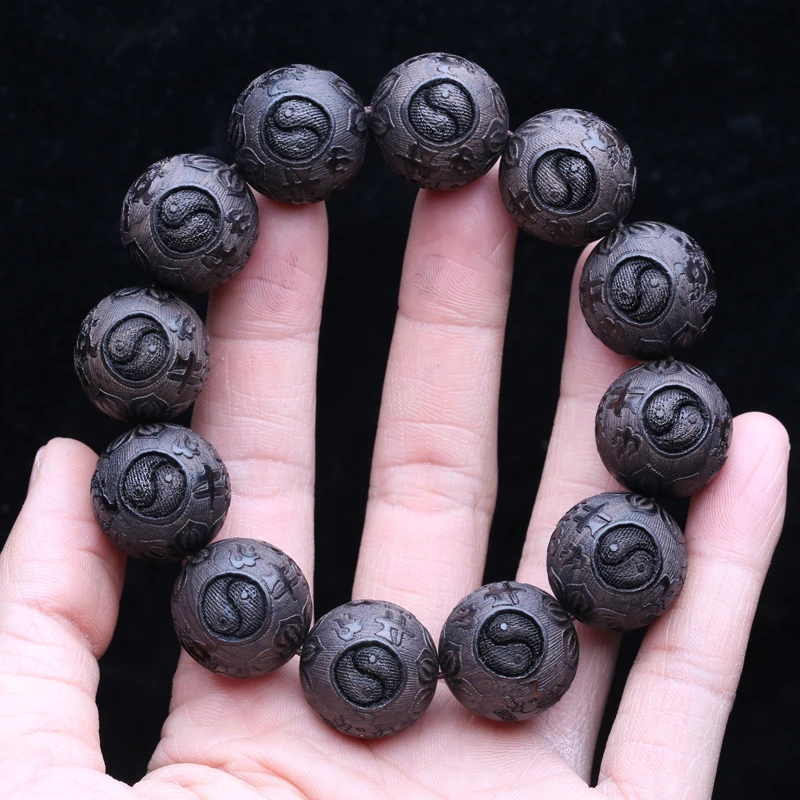
“Turn the situation around”: niǔzhuǎn qiánkūn
The listing says: “turn the situation around … mascot cow.”
What the photos show: every bead carries a yin-yang medallion, surrounded by smaller carvings, some of which look like Chinese characters. We can’t see an ox on the main photo.
What we found: the name translates the idiom 扭转乾坤 (niǔzhuǎn qiánkūn): to turn heaven and earth around, meaning to reverse a situation. Qián 乾 and kūn 坤 are also the names of the heaven and earth trigrams of the bagua (Wikipedia), so a yin-yang carving fits the idiom’s imagery. The “cow” most likely comes from a Year of the Ox pun: niǔ (扭, “to twist”) is swapped for its homophone niú (牛, “ox”), turning the idiom into a New Year greeting. Two independent sources agree on the pun (Language Log, University of Pennsylvania; ChinesePod dictionary).
What we can’t say yet: what the characters around the medallions say, and whether an ox appears anywhere on the bracelet.
Verdict: 🟡 Partial — the idiom and the pun are verified; the link to our carving is plausible but not yet checked, and the ox isn’t visible.
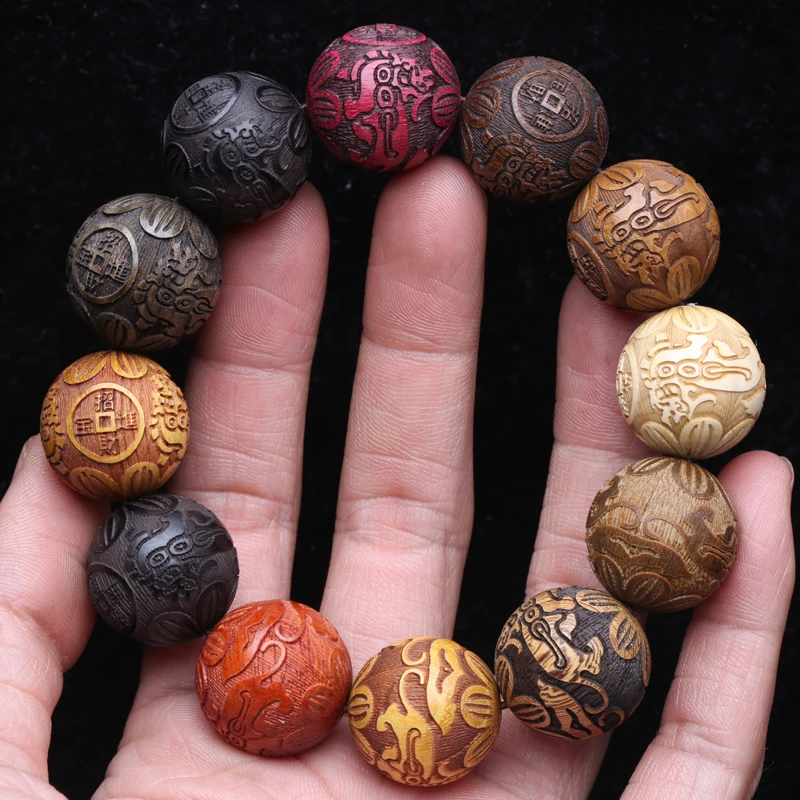
The mythical animal
The listing says: “lucky sculpture, mythical animal” — with no name.
What we found: the animal most often carved on Chinese wealth bracelets is the pixiu. Its image goes back to Han dynasty stone carvings, and it comes in winged and wingless forms (Chow Sang Sang). Rules you will see online — wear it on the left hand, head facing outwards — are feng shui beliefs published by jewelers, not facts anyone can check.
What the photos show: each bead is a different wood with a different carving — animals, patterns, and at least one round coin with a square hole, the traditional wealth symbol (Gotheborg).
What we can’t say yet: whether the animals include a pixiu, a qilin or something else. Until we can identify them, we won’t name them.
Verdict: ⚪ Still investigating.
The “classic book”: a sutra, not a lucky motif
The listing says: “Tibetan Buddhism, classic book.”
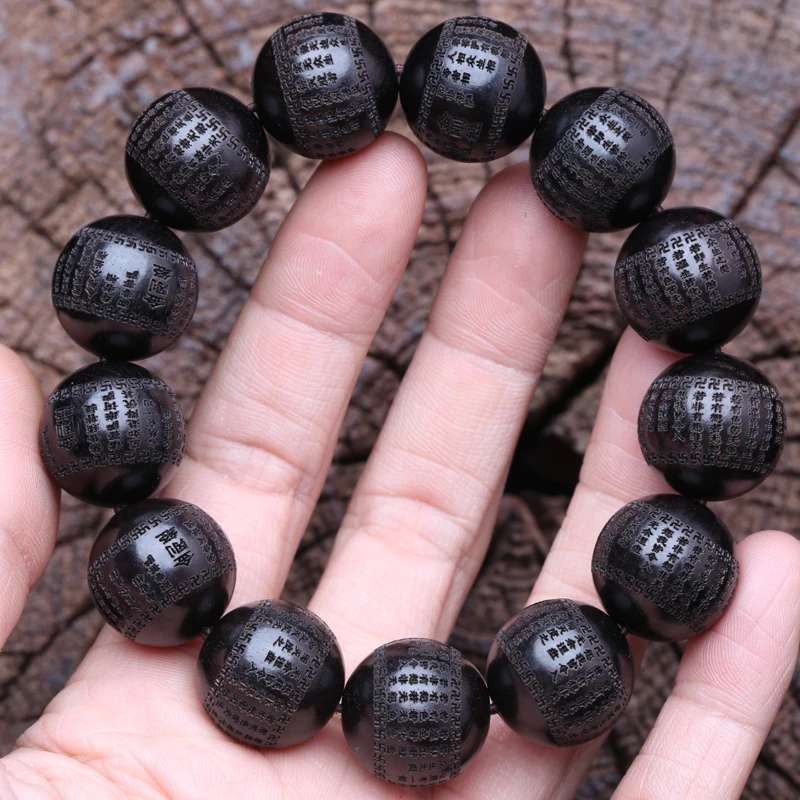
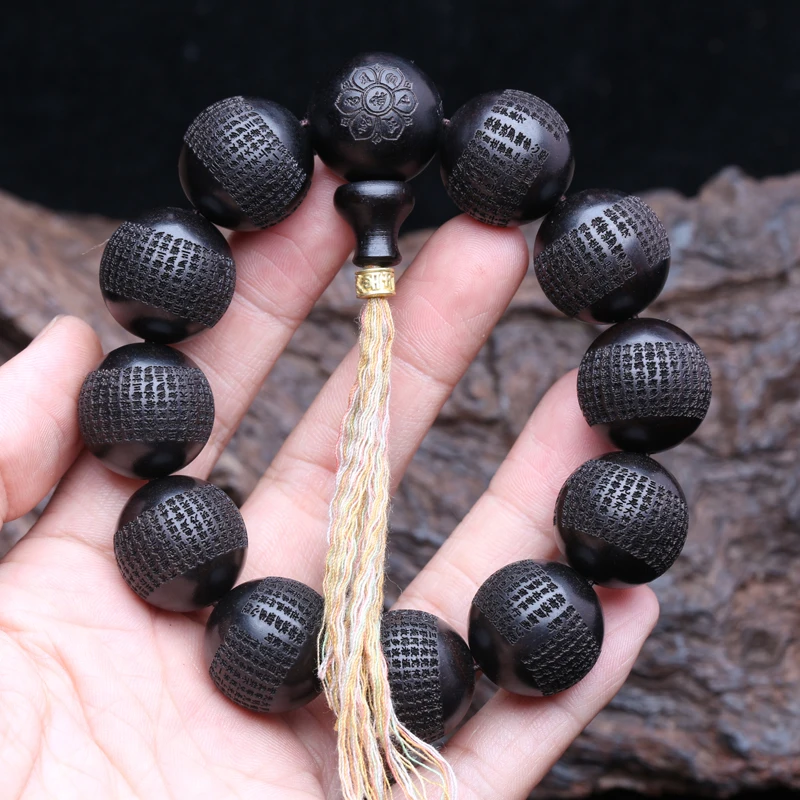
What the photos show: columns of tiny characters inside borders of 卍 signs. We read the phrase 人相、眾生相、壽者相, part of the four “notions” the Diamond Sutra teaches letting go of (NTI Buddhist Text Reader; Diamond Sutra, Chinese text). Larger characters on one bead look like 金剛經, the sutra’s Chinese title. “Classic book” is then a machine translation of 經 jīng, “scripture”.
Verdict: 🟡 Partial — “Buddhist” holds if our reading is confirmed; “Tibetan” doesn’t, the text is in Chinese. Our reading needs a second reader.
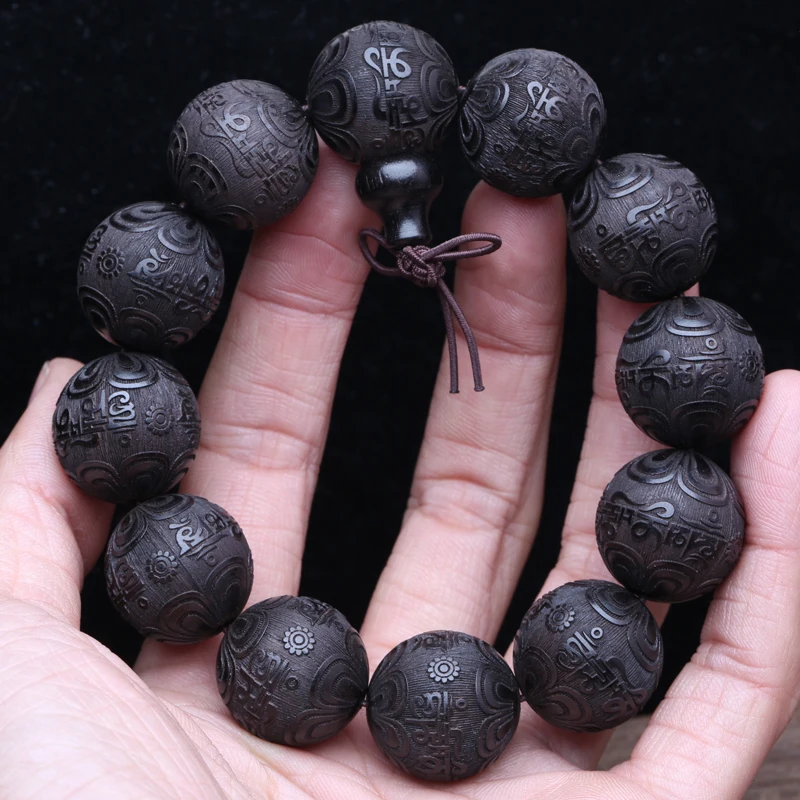
The “feng shui” amulet
The listing says: “feng shui, zen, amulet.”
What the photos show: letters that look like an Indic script, similar to our mantra bracelet, and one bead with a flower-like emblem. Nothing resembles a feng shui motif.
Verdict: ⚪ Still investigating — the script is unidentified; “feng shui” finds no support in the carving.
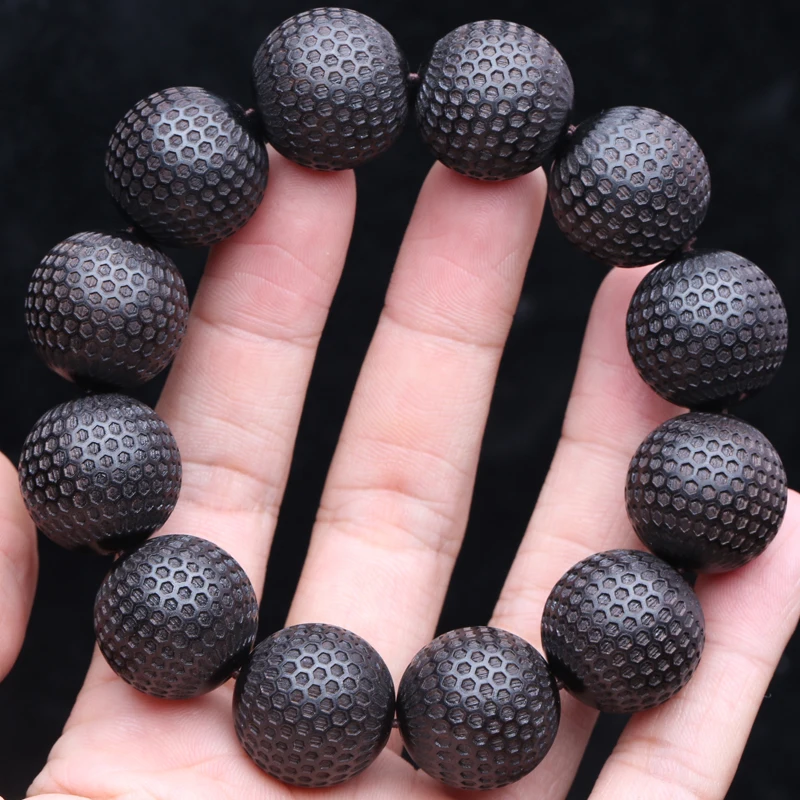
The 20 mm “good luck” carving
The listing says: “carved, good luck.”
What the photos show: a fine dimpled texture over every bead — no character, animal, object or pattern with a lucky meaning.
Verdict: 🔴 Vibes only — “good luck” has no basis in the carving, going by the listing photos. Physical check pending.
Tibetan script and ritual objects
Here the “Tibetan” label at least points somewhere checkable: a mantra is written in a real script that someone fluent can read.
Om mani padme hum
What it is: the best-known mantra of Tibetan Buddhism — six syllables in Sanskrit, associated with Avalokiteśvara, the bodhisattva of compassion. The first and last syllables, oṃ and hūṃ, are sacred sounds without a dictionary meaning (Wikipedia).
The translation everyone repeats: almost every shop renders the mantra as “the jewel in the lotus.” Scholars dispute that reading. Citing Tibetan grammatical sources, the Buddhologist Donald Lopez argues that maṇipadme more likely addresses a bodhisattva called “Jewel-Lotus” — an epithet of Avalokiteśvara — rather than describing a jewel inside a lotus (Wikipedia). Another scholarly suggestion is that it first invoked a female figure named Manipadma (BabelStone). Claims that the bracelet brings protection or luck are sellers’ promises; we don’t make them.
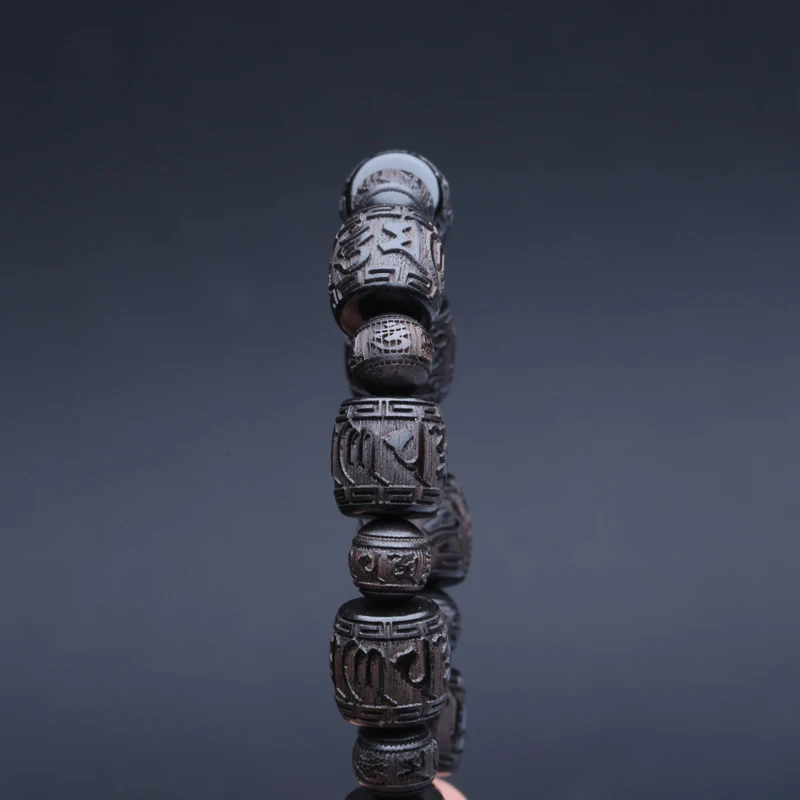
What the photos show: barrel-shaped beads carved with letters of an Indic-looking script. The mantra is often carved in Lantsa or Tibetan script (BabelStone, Mani stones in many scripts).
What we can’t say yet: which script is carved on our beads, and whether it actually spells the mantra.
Verdict: ⚪ Still investigating — the mantra is documented, our carving is not yet read.
More on the mantra and its scripts: Om mani padme hum guide.
The “Tibetan” amulet
The listing says: “Tibetan Buddhist, amulet.”
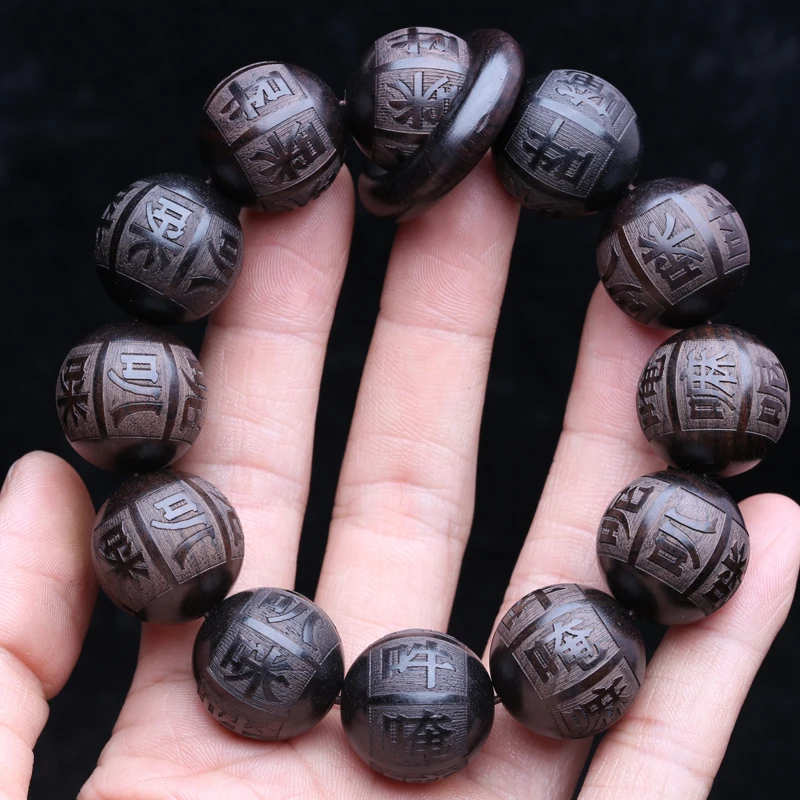
What the photos show: large Chinese characters, not Tibetan script. We read 叭, 咪 and 吽, and very likely 唵 — four of the six characters Chinese uses to write Om mani padme hum, 唵嘛呢叭咪吽 (Wikipedia; ChinesePod dictionary). Details in our Om mani padme hum guide.
Verdict: 🟡 Partial — “Buddhist” holds if a second reader confirms; “Tibetan” doesn’t, the script is Chinese.
The prayer wheel
We covered this one in its own episode: The Bracelet That Can’t Actually Turn. The verdict and sources are there.
The ritual tools
The listing says: “Tibetan Buddhist tools, 12 beads.” Tibetan Buddhism does use ritual implements, but the listing names none of them, and we have not identified the objects carved on the beads.
Verdict: ⚪ Still investigating.
A Chinese symbol: yin yang (and the missing trigrams)
The listing says: “symbol of philosophy, symbol of divination.”
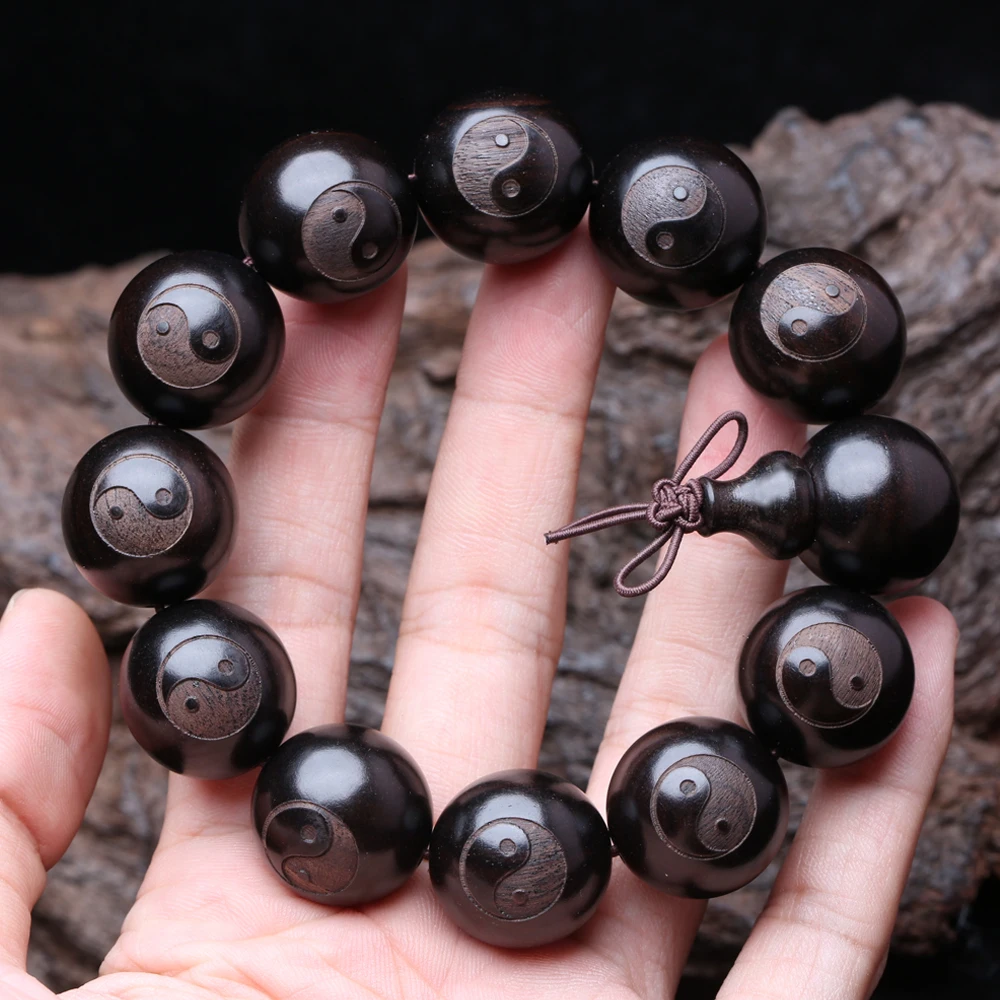
What the photos show: a yin-yang symbol engraved on each polished bead, and one gourd-shaped bead. No trigrams are visible.
What we found: yin yang is a core idea of Chinese philosophy, so “philosophy” holds. The divination link comes from the bagua: eight trigrams of three broken (yin) or unbroken (yang) lines, tied to the divination practice of the I Ching (Wikipedia). Those trigrams often ring the yin-yang on other bracelets — but not on ours, going by the photos.
Verdict: 🟡 Partial — “philosophy” holds; “divination” isn’t supported by what is carved. Based on the listing photos, physical check pending.
Plain woods: sandalwood and rosewood
With no carving, the main claim is the wood. The rosewood bracelet also has two gourd-shaped beads and a wood-slice pendant, but its beads are plain. “Sandalwood” and “rosewood” are trade names that can cover several different trees, and some rosewood species are protected. We are checking the species and the sourcing of both, and will publish what we find.
The same question applies to ebony. Ebony comes from slow-growing Diospyros trees, and high demand has led to severe overharvesting worldwide (Wikipedia). Where our ebony comes from will be the subject of its own episode.
One finding already: our “sandalwood” bracelet is olive green on every photo — the colour of “green sandalwood”, or verawood, which is not true sandalwood. Details in our wood guide.
Verdict: 🟡 Partial for the sandalwood (probably green sandalwood, not genuine), ⚪ for the rosewood (species unknown).
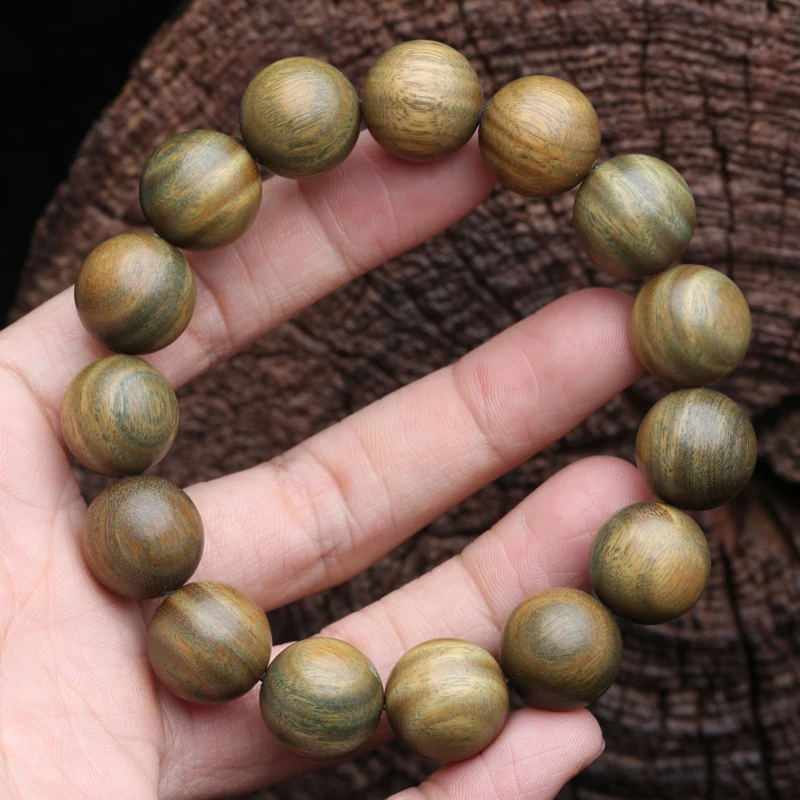
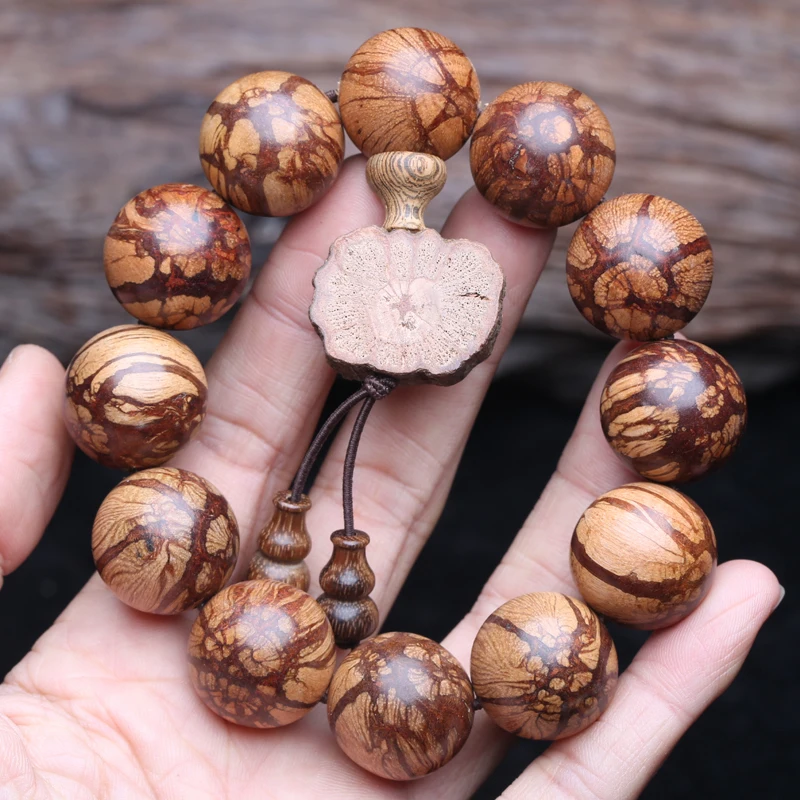
→ Sandalwood Bead Bracelet, 15 mm · Rosewood Bead Bracelet, 20 mm
How to identify what’s carved on your own bracelet
The same questions we ask, in the order we ask them:
- A row of letters running around the bead → probably a mantra. Count the syllables: om mani padme hum has six.
- A single character inside a circle → a Chinese auspicious character, as in episode 1.
- Swirling, scroll-like shapes → auspicious clouds (xiangyun).
- A black-and-white swirl → yin yang. Broken and unbroken lines around it → the bagua trigrams.
- Chinese characters with a 口 component on each bead → possibly a mantra written in Chinese, such as 唵嘛呢叭咪吽.
- An animal → note wings, horns and the shape of the head before looking up names.
- Still unsure → send us a clear, well-lit photo. We’ll add it to our checks.
Which bead size: 12, 15, 18 or 20 mm?
Men’s bead guides usually stop at 10 to 12 mm (Caligio). Ours run from 12 to 20 mm, so fewer beads go around the wrist and each one shows more of the carving. Measure your wrist first with our wrist size guide; our 20 mm bead guide covers fit and weight.
Frequently asked questions
Are these bracelets Buddhist?
Some are, or may be: the Diamond Sutra bracelet if our reading is confirmed, and the mantra bracelets once their scripts are read. Most others use Chinese lucky motifs, which have their own tradition, largely separate from Buddhism.
Can I wear one if I’m not Buddhist?
Buddhist writers generally say yes, as long as you understand the symbol and treat it with respect (Just Buddha). For most of our bracelets the question doesn’t arise: they are decorative, not religious objects. For the mantra bracelet, know what it says and don’t treat it carelessly.
Which wrist should I wear it on?
The “left hand receives” rule comes from feng shui guidance published by jewelers (Chow Sang Sang). We found no source making it a Buddhist rule. Wear it where it’s comfortable.
Is the ebony real?
On the bracelet we audited, yes (episode 1). The others will be checked in an episode dedicated to our ebony.
Can a wood bracelet get wet?
Take it off before showering or swimming. Repeated soaking can crack wood and wears out the elastic cord faster.
Help us close the open verdicts
If you read Chinese or Tibetan and recognize a carving above, email a note — ideally with how you know — to contact@lochness-paris.com. We’ll update the verdict publicly and credit you.
Sources
- Wikipedia — Xiangyun (auspicious clouds)
- Gotheborg — Chinese auspicious motifs, glossary
- Language Log (University of Pennsylvania) — niú zhuǎn qiánkūn
- ChinesePod — dictionary entry 扭转
- Chow Sang Sang — Pixiu meaning and wearing guide
- Wikipedia — Om mani padme hum
- BabelStone — Mani stones in many scripts
- ChinesePod — dictionary entry 唵嘛呢叭咪吽
- Wikipedia — Bagua
- Gotheborg — Eight Precious Things
- NTI Buddhist Text Reader — 壽者相
- Diamond Sutra, Chinese text (Chung Tai Zen Center of Sunnyvale)
- Wikipedia — Ebony
- Just Buddha — Is Buddha jewelry disrespectful?
- Caligio — Bead size guide for men
Update log
[À COMPLÉTER : date] — First publication. 7 verdicts open, 5 partial, 1 vibes only; the prayer wheel is covered in its own episode.