
18 Popular Symbols of Death and Mourning
Throughout history, humans have found ways to cope with death, grief, and the circle of life through symbolism. Traditional and modern art and culture are full of imagery related to death and the passage of life. It’s interesting to compare these vast histories and cultures around the world to see where they overlap and diverge.
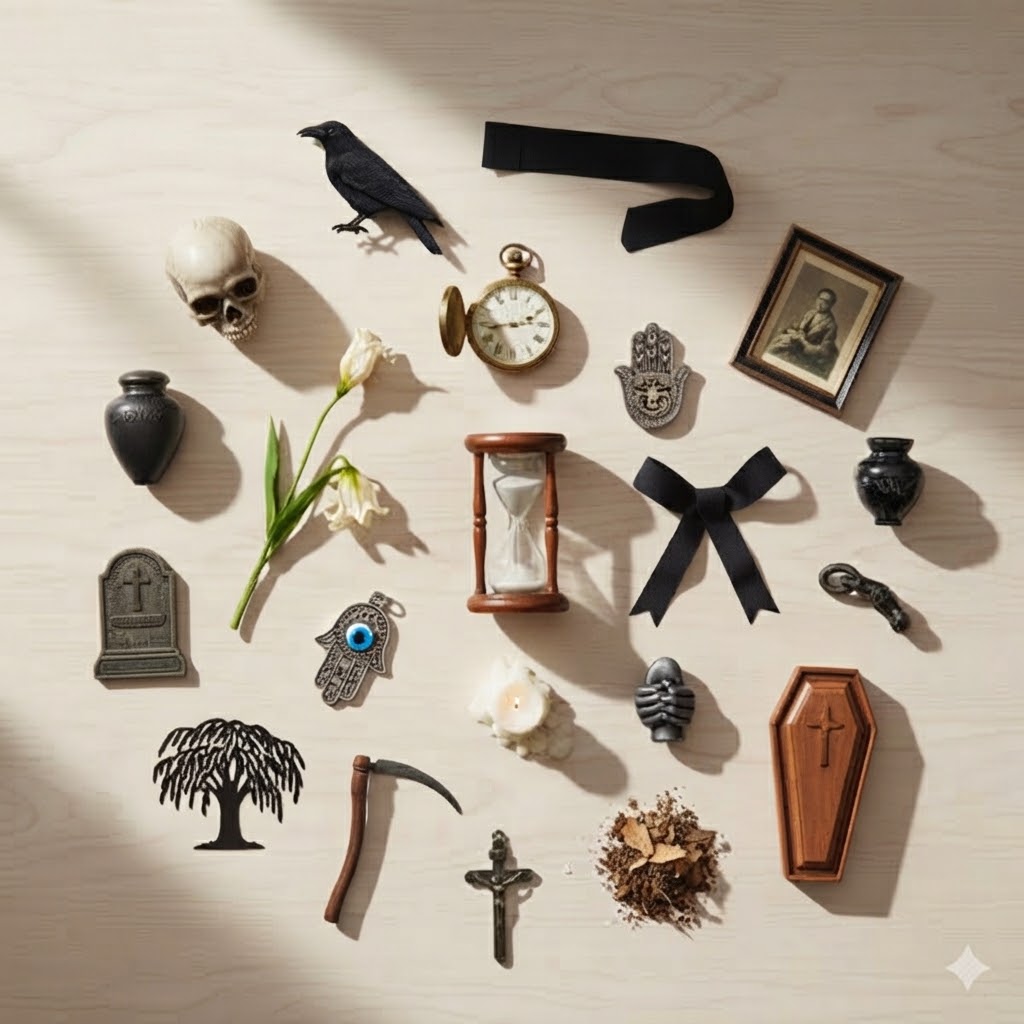
Death has been symbolized as an anthropomorphic figure or as an unreal individual in a great many popular cultures and in certain mythologies. How many death symbols and mourning symbols can you name? Some are common and feature prominently in American funeral practices and funerary decorations. Others are less obvious, hiding in the shadows where you’d least expect them. Either way, you’re bound to be surprised by this complete list of 18 popular symbols of death and mourning below. From movies to television to nature, you’ll begin to realize that these images are just as much a part of life as death itself.
Animals Associated with Death and Mourning
Animals are part of nature. As such, they have become symbols in their own right. Some animals carry darker connotations than others, though all of them remain perfectly unaware of their own fate in human interpretations. Most of the animals below are also considered signs of bad luck, so be careful.
1. Raven
The raven has a long history of association with death and mourning in American and European culture alike. Most of its popular interpretation probably comes from Edgar Allan Poe’s poem of the same name — required reading in most U.S. high schools. The raven in Poe’s poem repeats “nevermore,” driving the narrator mad with its repetition. However, this infamous raven had its dark beginnings even earlier than 19th-century poets. Birds traditionally carried a great deal of symbolism in Christianity. Ravens, in particular, are considered representations of the devil.
2. Vultures
Like the raven, vultures are black birds. However, ravens are quiet and small. They blend into the night. Vultures, on the other hand, demand to be seen. These birds literally feed on death. Their main diet consists of the carcasses of other animals. Although they play an important role in the environment by cleaning up waste, they are also an undeniable representation of death.
3. Ram
The ram (particularly the ram’s head) is also linked to death. The official emblem of the Church of Satan features a ram’s head, which now connects rams to occultism in the popular imagination. The ram is also associated with other deities around the world that featured long horns. Over time, these took on a darker turn to symbolize ritual and death.
4. Black Cats
Superstition around black cats comes to life every year around Halloween, one of the biggest seasonal traditions in the U.S. If a black cat crosses your path, bad luck is sure to follow. In 16th-century Italy, people believed that a black cat lying on a sick person’s bed meant certain death. Germanic peoples also believed a black cat was a sign of death. While these animals are probably misunderstood, it’s still an interesting story.
5. Bats
Thanks to vampire folklore, bats have also earned a place on this list. Beyond Dracula, bats are an omen of negative energy. These creatures thrive in darkness, and they have become symbols of the underworld and of death.
Plant Symbols of Death and Mourning
The meanings of flowers go back centuries, and flowers are a form of communication in their own right. Some of these meanings tell a story of death and mourning. Flowers are also living proof that the most beautiful images can hide a deep emotional meaning.
6. Red Poppies
The red poppy is the flower used to remember those who fell during the First and Second World Wars, worn every year in the U.S. around Memorial Day and Veterans Day. The poppy is actually one of the only plants able to grow naturally in the disturbed soil of Western Europe. After the war ravaged the country, poppies bloomed. The red poppy resembled the blood of fallen soldiers. Even now, years later, this flower remains a symbol of war, death, and remembrance.
7. Cypress
If you’ve ever walked through a cemetery in a warm climate — California, Louisiana, or the Mediterranean — chances are you’ve noticed cypress trees. These tall trees were not planted in cemeteries by accident. Because of their shape, cypresses seem to reach for the sky. Their roots grow in a way that doesn’t disturb the coffins in the ground. Beautiful and majestic, these trees now watch over cemeteries around the world.
8. Hyacinth
The hyacinth flower is a symbol of sorrow and pain. These are common funeral flowers because of this meaning, and it’s a creative way to honor someone and their grieving family. These blooming purple flowers offer encouragement when it’s needed. In times of loss, we sometimes need a little beauty.
9. Chrysanthemums
Although these flowers are often a sign of encouragement, they are also commonly found at graves. Humans have cultivated chrysanthemums for thousands of years. In 15th-century China, people believed these flowers held the power of life. Although they’ve come a long way, you’re still likely to see mums at funerals and cemeteries in the U.S. today. That doesn’t make them any less beautiful.
10. Lily
The lily plays an important role in ancient mythology, so it’s no surprise that it also has ties to human death and mourning. Today, lilies are one of the most common funeral flowers in American funeral homes. Thanks to their pale color, they serve as a way to remind the grieving family of a return to innocence after death. This shows that not all symbols of death are sad ones.
Objects or Phenomena Symbolizing Death and Mourning
Beyond animals and plants, there are additional symbols of death and mourning. These developed over time through literature, art, myth, and religion.
11. Candles
Candles are common at funerals, memorials, and other death-related traditions. In some cultures, such as in Latin America, candles are a way of bringing families closer to their deceased relatives on certain days of the year, like Día de los Muertos — now widely celebrated across the American Southwest. Candles support both religious and cultural rituals, such as lighting a candle for someone who has passed, helping to bridge the gap between the living and the dead.
12. Clocks
Clocks and other symbols of time, such as hourglasses or sundials, remind us all that our time on Earth is limited. Every passing minute is a minute closer to death. In many cultures, the family stops the clocks in the house at the moment of death to pay tribute to the deceased. Regardless, the ticking of time never stops.
13. Flag at Half-Mast
If you’ve ever seen the American flag flying at half-staff, you may wonder what happened or who died. Flying a flag at half-staff (halfway up the pole) is a sign of mourning, and in the U.S. it’s often ordered by the President or a state governor to honor a fallen public figure or mark a national tragedy. It’s a respectful way to honor the death of an important person or to offer condolences after a tragedy. The empty space at the top of the pole represents the invisible flag of death.
14. The Color Black
Of course, no list of death symbols would be complete without the color black. It’s the color we wear to funerals in Western cultures, including throughout the U.S. It is dark, reflecting the fading light of the soul as we merge into the afterlife. Why is black so strongly associated with death? It’s a practice that dates back to ancient times. In the Middle Ages and the Victorian era, mourning clothes were always black to show an outward expression of inner feelings of turmoil — a tradition that still shapes American funeral etiquette today.
15. Skull
The most memorable scene in Shakespeare’s Hamlet is when the Prince of Denmark holds the skull of his former servant. The skull (death’s head) has long been a symbol of death. It reminds us that we are all just bones underneath, and that life is fleeting.
16. Scythe
The infamous Grim Reaper himself, a fixture of American Halloween imagery, is often depicted carrying a scythe. A scythe is a type of curved, sharp blade that sits at the end of a long handle. This comes from pagan harvest ceremonies, but rumor also has it as a way to “cut down” the living.
17. Tombstones
Tombstones themselves are a symbol of death. These are used as grave markers. They show where loved ones are buried in the ground. The tombstone is a legacy in itself. Usually made of stone, it’s a way for the deceased to keep their memory alive after death.
18. The Black Ribbon
This small piece of black fabric worn on clothing signifies mourning for a widower or widow. A discreet dress code, a distinctive social marker of the grief inherent in the death of a loved one.
Find Peace Through Symbolism
The symbols above have gained popularity for bringing meaning and peace to the unyielding nature of death. Although the end of life is inevitable, peace is possible if we look to nature and stories for signs of hope. From the familiar skull to the watchful eye of a raven, these images have earned their place in American and world history alike. By exploring the culture and symbolism surrounding death, we take steps toward accepting our own mortality. Death is the great equalizer, but we must not let it stop us from living a full life.
Many people find comfort in carrying one of these symbols close, as a quiet, personal way to honor someone they’ve lost. If that’s something you’re considering, a handcrafted memorial bracelet lets you choose a symbol that means something to you — a poppy for remembrance, a raven for transformation, a lily for peace — and wear it every day as a small, steady reminder that love doesn’t end with loss.