

By Camille G., founder of Loch Ness · Reading time ≈ 5 min
Walk into most jewelry stores and you’ll find two separate aisles: delicate, pastel-toned pieces for women, and chunky, dark-stone pieces for men. It’s a convenient split for merchandising — but it has very little to do with how fine stones actually work, or with what people increasingly want to wear. Here’s what genuinely differs between a “men’s” and a “women’s” bracelet in fine stones, and what’s really just marketing.
1. What actually changes: size, not substance
The one measurable difference is wrist circumference. On average, women’s wrists measure between 13 and 18 cm, while men’s typically run from 15 to 20 cm — with plenty of overlap in between. That’s a sizing question, not a design one: the same amethyst or labradorite bead looks and behaves identically regardless of who wears it. A bracelet “for him” or “for her” is, in practice, the same bracelet built on a different length of cord.
2. The trend is moving toward unisex, not away from it
The jewelry industry itself is walking back the strict gender split. Fine jewelry maisons have started photographing the same pieces on both male and female models, and launched their first bracelet lines explicitly designed for a mixed audience. Industry analysts describe men’s fine jewelry as growing steadily, but the sharper trend is toward unisex and gender-neutral designs that let the stone — not the label — do the talking.
3. Where a real design difference can make sense
That doesn’t mean every bracelet should look identical. Some genuine, reasonable preferences show up in aggregate:
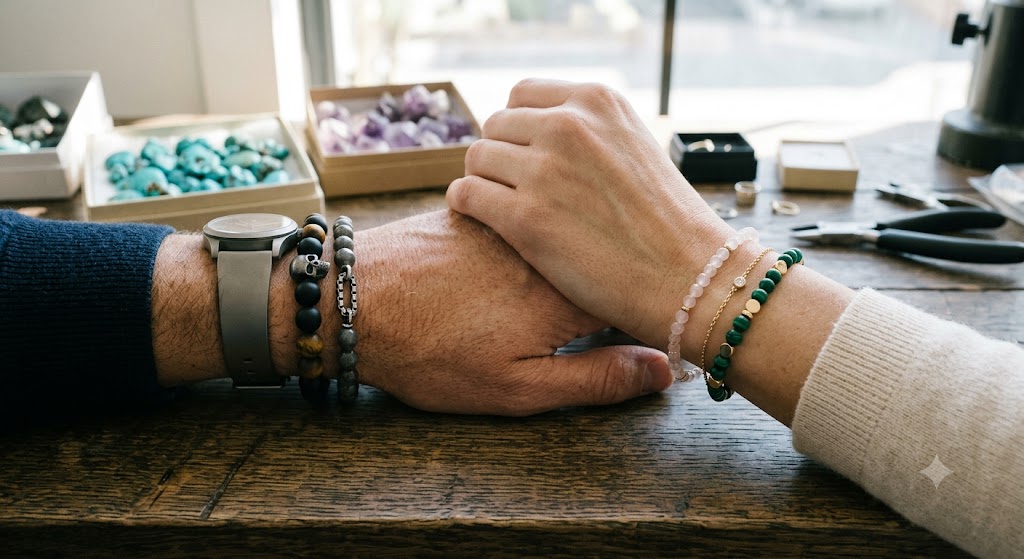
- Bead size: larger, bolder beads (10-12mm) often read as more traditionally masculine; smaller beads (6-8mm) as more delicate — but this is a style choice, not a rule.
- Stone palette: darker, more opaque stones (onyx, hematite, tiger’s eye) are frequently chosen for a bolder look, while lighter or translucent stones (rose quartz, moonstone) lean softer — again, a preference, not a boundary.
- Stacking habits: women more often wear multiple thin bracelets together; men more often wear a single, slightly heavier piece.
None of this is a hard rule — it’s simply what most people gravitate toward when left with an unlimited catalog and no aisle to guide them.
4. Why a configurator solves this better than a fixed collection
A pre-made “men’s collection” or “women’s collection” forces a guess before you’ve even seen the person’s actual wrist or actual taste. A bracelet configurator sidesteps the whole problem: you pick the stones, the bead size, and the exact length yourself — there’s no pre-sorted men’s or women’s version to choose between in the first place. The same amethyst-and-labradorite combination that looks striking on one wrist looks equally striking on another, because nothing about the stone itself was ever gendered.
Design your own, without the gender guesswork
Choose every stone, set the exact length, and see it come to life in real time — no pre-sorted collection to compromise on.
Sources: Fortune Business Insights, Jewelry Market Size, Share & Growth Report (2026) · Made in FR, Le marché des bijoux pour homme en France · Strategic Revenue Insights, Luxury Jewelry Market Size & Forecast (2026)