Table of Contents
- What “apotropaic” means, and why it matters here
- Why civilizations kept returning to “the eye”
- Eclipses as omens: a nearly universal fear
- The Eye of Horus: the one myth that actually describes an eclipse
- From Wedjat to nazar: a real connection, or a popular story?
- A parallel hand: the hamsa and its own claimed link to Horus
- Ayin hara: the evil eye in Jewish tradition
- What we actually know, versus what gets repeated
- Why the distinction matters, beyond academic curiosity
- Sources
What “apotropaic” means, and why it matters here
Before going further, one word will come up repeatedly, and it’s worth defining rather than assuming: apotropaic, from the Greek apotrepein, “to turn away.” In the study of religion and material culture, it describes any object, symbol, or gesture whose purpose is to avert harm — not to bring good fortune actively, but to deflect a specific danger before it arrives. This distinction matters more than it first appears. A four-leaf clover is a luck charm; it invites something good. A wedjat eye, a nazar bead, or a hamsa is apotropaic; it repels something bad, specifically the effect of an envious or malicious gaze.
Every symbol discussed in this article belongs to that second category. Understanding them as apotropaic devices, rather than generic “protection symbols,” is what allows their similarities and their genuine differences to be compared with any precision.
Why civilizations kept returning to “the eye”
Long before any of these traditions could plausibly have influenced one another, cultures separated by thousands of kilometers converged on the same apotropaic idea: a watchful eye, worn or displayed, to intercept harm before it reaches its target. The oldest eye-focused objects usually cited in this story come from northern Syria, at Tell Brak, where archaeologists uncovered what is now called the “Eye Temple” — a structure that yielded hundreds of small alabaster eye-idols dating to the fourth millennium BCE. Be careful with the shortcut, though: the museums that hold them don’t describe them as protective amulets. The British Museum suggests they may represent worshippers placed as offerings (British Museum), and the Met explains that wide eyes show attentiveness to the gods (The Met). They show how old the fascination with the eye is, not that the evil eye amulet began there.
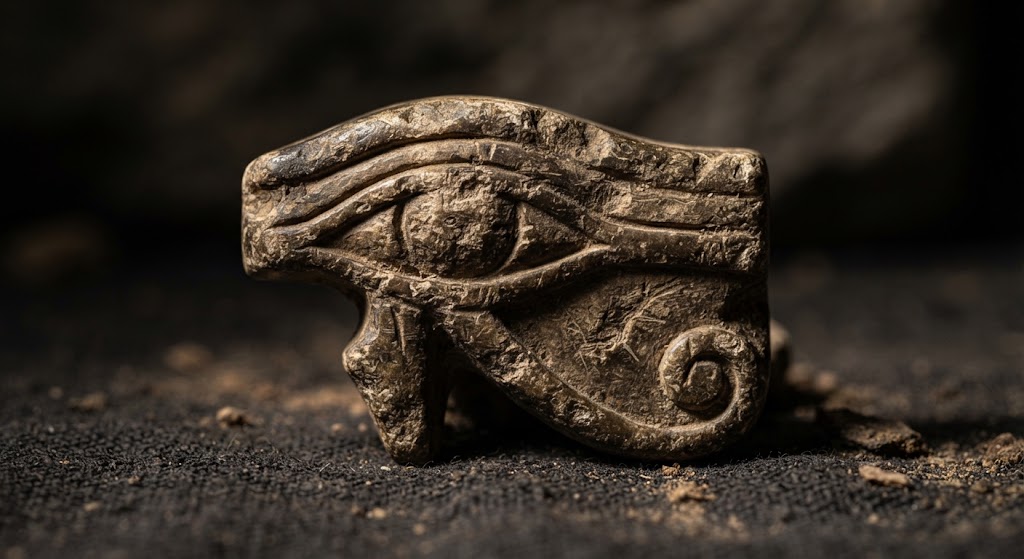
Egypt developed its own apotropaic eye independently: the wedjat, in use from at least the Middle Kingdom (roughly 2055–1650 BCE) onward, crafted in faience, carnelian, lapis lazuli, and gold, and placed both among mummy wrappings and worn by the living. Greece had its own variant entirely — sixth-century BCE Attic drinking cups painted with exaggerated staring eyes, designed so that as a drinker raised the cup to their lips, the painted gaze would ward off both evil spirits and the envious glances of fellow guests.
This matters for everything that follows: the apotropaic eye is not one invention that radiated outward from a single source. It is a pattern that several civilizations reached on their own, under broadly similar cultural pressures — a documented case of what anthropologists call convergent cultural evolution, not straightforward diffusion from a single origin point.
Eclipses as omens: a nearly universal fear
Across cultures with no plausible contact with one another, a darkened sun or moon was read the same way: as catastrophe, or at minimum, as warning. Ancient Greek accounts describe eclipses as evidence that the gods had turned angry. In Vietnamese folklore, an evil toad-spirit was said to swallow the sun. A 16th-century missionary’s account of the Aztec response to an eclipse describes open panic — shouting, sacrifice, and a widespread fear that the sun might vanish permanently, ushering in demons of darkness.
The fear extended, in many traditions, specifically to pregnant women and children — considered uniquely vulnerable during the event. A Mexican folk tradition, still practiced by some families into the 20th century, holds that a metal safety pin worn near the belly during an eclipse reflects its dangerous power away from an unborn child. In parts of India, food prepared during an eclipse was — and in some households, still is — considered impure or even poisonous, prompting fasting until the event passes.
None of these eclipse traditions mention the evil eye by name, or reference an eye-shaped amulet at all. This is a genuinely separate branch of belief — “a celestial event signals danger” — running in parallel to, not through, the apotropaic eye traditions discussed below.
The Eye of Horus: the one myth that actually describes an eclipse
This is where a specific, well-documented connection to the eclipse itself appears — not yet to the evil eye, but to the astronomical event. In Egyptian mythology, Horus’s right eye represented the sun, his left eye the moon. The central myth: Set, Horus’s rival and the murderer of his father Osiris, tears out or destroys Horus’s eye during their conflict. The eye is subsequently healed and restored — in most surviving versions, by the god Thoth; in others, by the goddess Hathor.
Egyptological sources describe how this myth was used to account for the moon’s own visible cycle: its waning was understood as the eye’s injury, its waxing as the eye’s restoration. A solar or lunar eclipse fits this framework with unusual precision — it is the exact moment at which the eye, sun or moon, is visibly wounded, immediately before it “heals” back into full view. The wedjat amulet itself, worn as a protective and funerary object from the Old Kingdom through the Roman period, carried this restorative meaning directly: to wear the healed eye was to invoke wholeness after injury, health after harm.
One caveat is worth stating precisely rather than glossing over. Not every Egyptologist agrees on how early this solar-lunar reading developed. Richard Wilkinson has argued that the association between Horus’s eyes and the sun and moon developed gradually over time, while other scholars note that no surviving text unambiguously links the two before the New Kingdom (roughly 1550–1070 BCE). Rolf Krauss has gone further, arguing that the eye originally represented the planet Venus in its morning-star and evening-star appearances, only later becoming associated with the moon specifically. The myth is real and the eclipse parallel is genuine; its precise chronology within Egyptian religious history is still an open scholarly question.
From Wedjat to nazar: a real connection, or a popular story?
This is the section where popular retellings most often overreach. It is common to read, across jewelry blogs and lifestyle sites, that the Turkish nazar — the concentric blue-and-white glass eye bead — descends in an unbroken line from the Egyptian wedjat. The claim is repeated often enough that it has come to read as settled history.
It is not, quite. What is documented: both symbols perform the same apotropaic function — deflecting harm channeled through an envious or malicious gaze — and both are extremely old, and Egypt’s cultural reach across the ancient Mediterranean, through trade, conquest, and religious exchange, is well established by conventional historical and archaeological record. What is not documented is a continuous archaeological chain of intermediate objects connecting Old Kingdom Egypt to Ottoman-era Anatolia, where the now-familiar cobalt-blue nazar bead became concentrated in glassworking centers around İzmir during the 19th and 20th centuries, with the nearby town of Görece emerging as a particular hub of production that continues today.
The more defensible reading of the evidence, based on the sources gathered here, is convergent evolution with likely mutual influence over an extremely long timescale — Mesopotamia, Egypt, and Greece each independently arriving at an eye-shaped apotropaic device, plausibly cross-pollinating each other’s traditions through centuries of trade and contact, without a single clean, provable line of descent running from one to the next. Historians of material culture generally treat the wedjat as one major tributary feeding into the broader Mediterranean “evil eye” tradition — a significant and probable influence, not a sole point of origin.
A parallel hand: the hamsa and its own claimed link to Horus
A second apotropaic symbol widens this picture considerably, and is rarely discussed alongside the wedjat despite a claimed connection to it: the hamsa, also known as the Hand of Fatima in Islamic tradition and the Hand of Miriam in Jewish tradition. The word itself derives from the Semitic root for the number five, referencing the hand’s five fingers — a number carrying its own apotropaic weight across multiple traditions independently of the hand shape itself.
The hamsa’s documented origins predate both Islam and Judaism by a wide margin. Early use has been traced to ancient Mesopotamian amulets associated with the goddess Inanna, or Ishtar — a deity of fertility, love, and war. Separately, the open right hand appears in Carthaginian and broader Phoenician material culture, including a Punic stela from Carthage dedicated to the deities Tanit and Baal Hammon, carved with an open right hand alongside other protective symbols. In this North African context, the hand of Tanit specifically was used to ward off the evil eye, centuries before the symbol acquired either of its later religious names.
Here is where the claimed Horus connection resurfaces, though on distinctly shakier ground than the wedjat-to-eclipse link discussed earlier. One theory traces the hamsa to the “Two Fingers” amulet of ancient Egypt, in which two extended fingers represented the gods Isis and Osiris, with the thumb representing their son — Horus. Some later interpretations extend this further, describing the hamsa as invoking “the eye of Horus” and the idea that “humans cannot escape the eye of conscience,” with the sun and moon again cited as Horus’s eyes. This particular chain of reasoning is considerably weaker than the eclipse connection above: it rests on source material explicitly flagged by researchers as needing better citation, and represents, at most, one proposed lineage among several competing origin theories rather than an established consensus.
Whatever its precise origin, the hamsa’s later history is well documented. Sephardic Jewish communities are believed to have been among the first to adopt the amulet specifically for its evil-eye protection, and the symbol appears in Kabbalistic manuscripts doubling as the Hebrew letter shin, the first letter of Shaddai, one of the names of God. The symbol’s apotropaic reputation was, at points, taken seriously enough to provoke institutional opposition: in 1526, an episcopal committee convened under Emperor Charles V decreed a ban on the Hand of Fatima and related open-hand amulets in formerly Islamic Spain, thirty-four years after the end of Muslim rule there — a rare case of an apotropaic folk symbol becoming significant enough to draw formal religious sanction.
Ayin hara: the evil eye in Jewish tradition
The hamsa’s Jewish usage points to a further thread worth naming directly: ayin hara, Hebrew for “evil eye,” a concept with its own distinct history within Jewish folklore and, in some readings, rabbinic literature. Where the Mediterranean nazar addresses the evil eye primarily through a manufactured eye-shaped object, ayin hara tradition draws more heavily on protective language, ritual gesture, and the hamsa itself — often inscribed with Hebrew text or paired with the Star of David — as its primary apotropaic tools, alongside the hand symbol discussed above.
This is worth flagging precisely because it demonstrates, once again, the pattern running through this entire article: the same underlying fear — that an envious or admiring gaze can transmit harm — recurring independently across Mesopotamian, Egyptian, Greek, Turkish, Arab, and Jewish traditions, each developing its own distinct apotropaic vocabulary to address it, with real but only partially documented cross-influence between them.
What we actually know, versus what gets repeated
| Claim | Status |
|---|---|
| Eclipses were widely feared as omens across unrelated cultures | Well documented |
| The Eye of Horus myth directly mirrors the mechanics of an eclipse (injury and healing of the sun/moon eye) | Well documented, though the exact dating of the sun/moon reading within Egyptian religious history is debated among Egyptologists |
| The evil eye and eclipses are directly linked in folklore | Not supported by the sources gathered here — these are separate, parallel traditions |
| The nazar descends directly, in an unbroken line, from the Egyptian wedjat | Popularly repeated, but not archaeologically proven — more defensibly framed as one major probable influence among several convergent traditions |
| The hamsa derives directly from the Eye of Horus | One proposed theory among several competing origin stories (Mesopotamian Inanna/Ishtar amulets and Carthaginian Tanit worship are at least as well attested), not an established consensus |
| Apotropaic eye and hand symbols appear independently across Mesopotamia, Egypt, Greece, and the Levant | Well documented, and the most defensible unifying claim in this entire subject |
Why the distinction matters, beyond academic curiosity
None of this scrutiny makes these symbols less meaningful to wear or to study — if anything, the accurate version of the story is more compelling than the tidy, single-origin version usually repeated. What it does mean is that a strong claim (“the nazar comes from Egypt,” “the hamsa is literally the Eye of Horus”) should be treated as a hypothesis worth citing carefully, not a settled fact worth repeating uncritically. Multiple ancient civilizations, working independently and later in likely contact with one another, converged on strikingly similar solutions to the same fear: that to be seen with envy or excessive admiration was itself a form of danger, and that an eye — or a hand — watching back could turn that danger aside.
Sources
- Eye of Horus — Wikipedia
- Horus (deity) — EBSCO Research Starters
- Encyclopedia: Evil Eye Amulet — SkyJems
- Encyclopedia: Evil Eye Nazar — SkyJems
- Encyclopedia: Hamsa — SkyJems
- Hamsa — Wikipedia
- Top Five Worst Superstitions About Solar Eclipses — Fox News
- Safety Pin Protection for Pregnant Woman During an Eclipse — USC Folklore Archive
This article distinguishes documented historical and archaeological fact from popular but unproven claims wherever the two diverge — a distinction worth preserving whenever ancient apotropaic symbolism is discussed, retold, or sold.
Related: The Evil Eye as Social Vigilance: What Anthropology Says About Envy, Suspicion, and Protection — on what believing in these symbols does to a community, rather than where the symbols came from — and Hammurabi’s Code and the Politics of Protection, on a written, state-sanctioned parallel to the same underlying pattern.
Updated September 27, 2026: the Tell Brak paragraph now reflects how the British Museum and the Met describe the eye-idols.