
Loch Ness · VERIFIED OR VIBES? · Lucky charms
By Camille G., founder of Loch Ness · Published September 27, 2026 · Last updated September 27, 2026
Among all lucky charm meanings, the evil eye is the most misunderstood. It is sold as a good-luck charm everywhere. In the culture most associated with it, it isn’t one.
The claim: “The evil eye brings good luck”
The belief behind it is that a look full of envy or excessive admiration can cause harm. The Turkish amulet, the nazar boncuğu, exists to repel that harm: it is about protection, not luck (Made in Turkey Tours). Its name says so: nazar comes from the Arabic for “sight” or “gaze”, and boncuk means “bead” (Memphis Tours). It works as a decoy that attracts the harmful gaze and absorbs it (TurkishFluent).
Verdict: 🔴 Vibes only for “luck”; the evil eye is traditionally a protection charm.
What the traditional bead looks like
A blue glass bead with concentric circles in dark blue, light blue and white, sometimes with a black dot in the centre. Handmade glass beads are the tradition, with some of the finest still made around İzmir (Dem Turkish Center). The village of Nazarköy, “Evil Eye Village”, has had bead workshops since its first kiln opened in 1942 (Memphis Tours).
The claim: “It is over 5,000 years old”
Many sites trace the evil eye amulet to “eye idols” found at Tell Brak, in Syria, dated to around 3300 BCE (Ottoman Hands). The objects are real: hundreds of small figurines with huge eyes, from a building called the Eye Temple. But the museums that hold them describe them differently. The British Museum suggests they may represent worshippers placed as offerings (British Museum); the Met explains that wide eyes show attentiveness to the gods (The Met). Neither calls them protection against the evil eye.
Verdict: 🟡 Partial — the belief is ancient and widespread, but the famous 5,000-year-old “first evil eyes” are interpreted by museums as offerings, not as amulets.
Our evil eye pendant
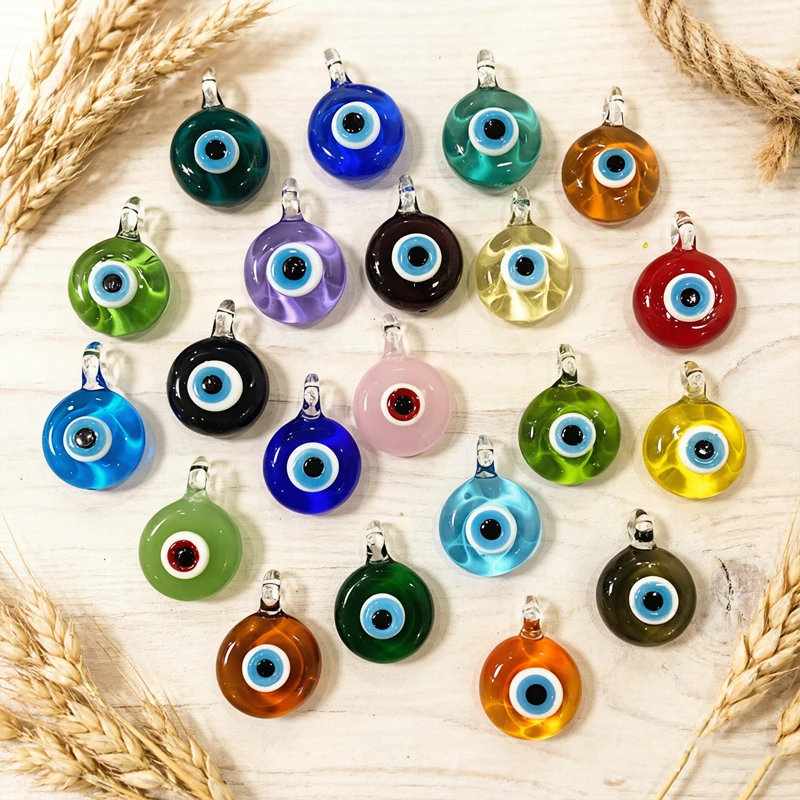
A small, colourful glass pendant, 2.1 cm, made for your own jewelry projects. It is multicoloured rather than traditional blue, and we don’t attach any power to it. → See the evil eye pendant
Two questions people ask next
- Do the colours mean something? Evil eye colours: where the charts come from
- What if the bead breaks? What to do when an evil eye bead breaks
The other classics
Four-leaf clover rarity · which way to hang a horseshoe · where the dreamcatcher comes from
Sources
- Made in Turkey Tours — History and meaning of the Turkish evil eye
- Memphis Tours — The nazar amulet
- TurkishFluent — What is nazar?
- Dem Turkish Center — Turkish evil eye beads
- Ottoman Hands — The meaning of evil eye
- British Museum — Eye idol, Tell Brak
- The Met — Eye idol, Tell Brak
Update log
September 27, 2026 — First publication.

About the author — Camille G., founder of Loch Ness
Full-stack developer and self-taught jewelry maker since 2013, Camille designs and codes every interactive experience on Loch Ness Lab — from the healing crystal bracelet configurator to the free tools at lochness-paris.com/apps, including the research behind the creativity test’s scoring algorithm.