
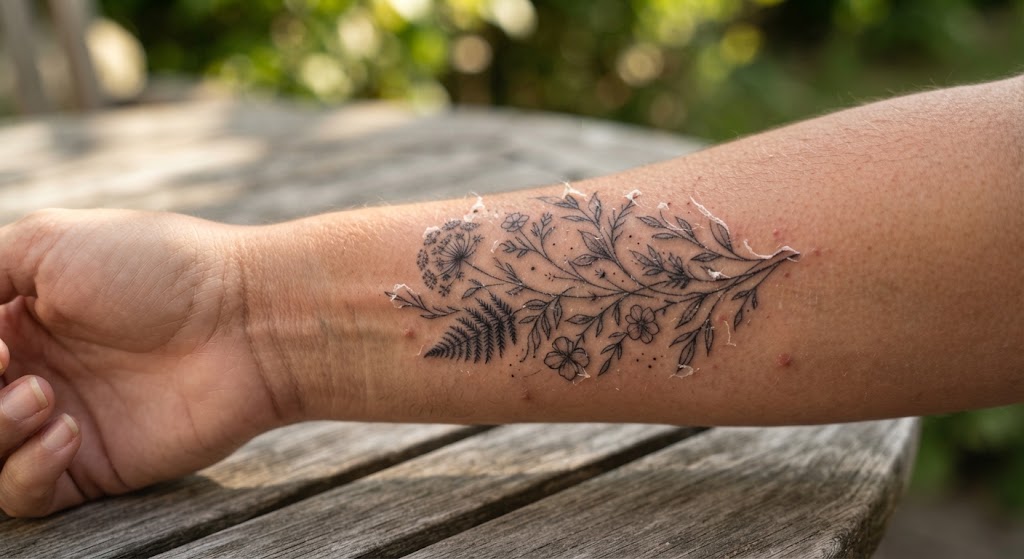
Both are “fake tattoos,” but they’re fundamentally different products — different material, application, look, and lifespan. Here’s how to choose.
Table of Contents
- How they work
- Appearance
- Durability
- Application time
- Customization
- Safety considerations
- Which should you choose?
- Frequently asked questions
How they work
Henna is a paste made from the dried, ground leaves of the henna plant, applied directly onto skin (typically hand-piped from a cone, like icing) and left to dry for several hours. The paste stains the top layer of skin a reddish-brown color as it’s absorbed, then flakes off, leaving the stain behind.
Temporary tattoo stickers are pre-printed designs on a transfer paper, applied to skin using water — the ink layer separates from the backing paper and adheres directly to the skin’s surface, similar to a decal.
Appearance
Henna produces a single-color, slightly textured, organic-looking stain — well suited to intricate mandala, floral, or lace-style patterns. Sticker tattoos can reproduce full-color, high-detail designs (including photorealistic images) that henna simply cannot achieve, since henna is limited to shades of brown.
Durability
Henna typically lasts 1–3 weeks, fading gradually as the stained skin naturally exfoliates. Stickers last considerably less — typically 3–7 days — and tend to peel at the edges before fully fading, which can look less graceful than henna’s gradual fade.
Application time
Henna requires real time and patience: piping the design takes anywhere from a few minutes (simple patterns) to over an hour (elaborate hand and arm designs), plus several hours of drying time before the paste can be removed. Sticker tattoos apply in under a minute with just water and light pressure.
Customization
Henna is typically hand-applied by an artist, making every design unique and adjustable in real time. Stickers come as fixed pre-printed designs — customization is limited to choosing from available designs or ordering a custom print in advance.
Safety considerations
Natural henna is generally safe for most people. The real safety concern is “black henna,” which often contains PPD, a chemical that can cause serious allergic reactions (see our durability and safety guide for more detail). Sticker tattoos use printed inks approved for temporary skin contact and are generally very low-risk, though people with adhesive sensitivities can occasionally react to the transfer backing.
Which should you choose?
- Choose henna if: you want an intricate, organic-looking design (especially for events like weddings or festivals with a henna tradition), and you have time for the application and drying process.
- Choose stickers if: you want a specific full-color image, need it applied in minutes, or are outfitting a group (parties, events) where speed matters.
Frequently asked questions
Can henna designs include color, like blue or green?
Natural henna only produces shades of brown. Products claiming to be “colored henna” (blue, green, black) are not real henna and often contain synthetic dyes with higher allergy risk.
Which one looks more like a real tattoo?
It depends on the design. For bold, colorful, or photorealistic designs, quality stickers look closer to real ink. For fine linework and organic patterns, henna’s slightly raised, textured stain can look more authentic than a flat sticker print.
Part of our Complete Guide to Fake Tattoos.