By Camille G., founder of Verumano.
The internet is facing a growing crisis of trust. Generative artificial intelligence can now produce illustrations, novels, music tracks, and videos that are sometimes difficult to distinguish from human-created work. For artists, writers, photographers, and musicians, one question is becoming increasingly important: how can creators demonstrate that their work genuinely results from human effort?
Several approaches are emerging to address this challenge. Some rely on a creator’s public commitment, such as the Not By AI badge. Others focus on cryptographic provenance, as with the C2PA standard (Coalition for Content Provenance and Authenticity). A third approach, represented by the Verumano protocol as described here, seeks to place the creative process and human review at the center of certification.
However, these solutions do not answer exactly the same question. Declaring that a work is human-made, tracing its technical history, and examining evidence of its creation are three different processes.
Can a work of art really be certified as 100% human-made (no AI)? And what guarantees can a certification provide without promising the impossible?
1. Self-Declared Labels: Trust Starts With the Creator
Not By AI: Making a Commitment to Human Creativity Visible
As AI-generated content becomes more widespread, some initiatives have adopted a straightforward approach: allowing creators to publicly express their commitment to human creativity.
One example is Not By AI, which offers badges for writers, artists, and other content creators.
The initiative uses a 90% rule: under the program’s stated criteria, at least 90% of the relevant content must be human-created. Certain limited uses of AI may be permitted, subject to the applicable rules for each type of content.
The badge acts as a signal to the audience. It communicates the creator’s position and makes their commitment to human creativity visible.
The Limitation: A Badge Is Not Technical Proof
A graphic badge can be copied, reproduced, or displayed without authorization. On its own, it does not establish a file’s origin or document the steps involved in creating it.
It is important, however, to distinguish the badge itself from the broader initiative. Not By AI also provides information about its program and terms of use. Its approach should not necessarily be reduced to a static image.
The fundamental limitation remains: a declaration, even when accompanied by a public commitment, does not automatically guarantee that every claim about a piece of content is accurate.
Key takeaway: A self-declared label can communicate an intention and make a commitment visible. It should not be confused with independent technical certification.
Source: Not By AI — The 90% Rule and Terms of Use.
2. C2PA: Tracing the Digital Provenance of Creative Work
What Is the C2PA Standard?
The Coalition for Content Provenance and Authenticity (C2PA) develops an open standard designed to document the provenance of digital content and the changes it undergoes.
Supported by organizations across the technology and media industries, the standard aims to provide verifiable information about the origin and history of images, videos, and other compatible files.
The technology is used in the broader ecosystem of Content Credentials, which provide information about the origin and editing history of digital content.
How Does C2PA Certification Work?
Consider a photograph taken with a compatible camera.
At capture, the system may record information about the file’s origin and associate it with a signed manifest. If the photograph is subsequently edited in compatible software, additional provenance information can be recorded to document the changes.
Digital signatures and cryptographic binding mechanisms allow certain properties of the manifest to be verified and can reveal modifications that are inconsistent with the recorded data.
However, this does not create a universal, infallible record of everything that has happened to an artwork since its creation. The quality of the available information depends on the tools used, the steps actually documented, and how the content is processed and distributed.
The official documentation describes this architecture in the C2PA Technical Specification.
Verifiable Provenance Does Not Mean Exclusively Human Creation
This is the crucial distinction.
C2PA is designed to make provenance information and certain claims associated with content verifiable. The standard does not, by itself, determine whether an artwork is artistically original, ethically acceptable, or exclusively created by a human.
An image generated by an AI system can also have valid provenance information documenting the use of that system.
A cryptographically valid manifest means that certain technical checks have succeeded. It does not guarantee that every statement contained in the manifest is factually true.
C2PA can help answer the question, “Where did this file come from, and what actions have been documented?” It cannot necessarily answer, “Was this work created entirely by a human?”
Is C2PA Only for Professionals?
It would be inaccurate to describe C2PA as inherently expensive or restricted to high-end equipment.
The standard is open and can be implemented in different hardware and software tools. Some applications may depend on specialized equipment, commercial services, or compatible paid software, but costs vary depending on the implementation.
For independent creators, the challenges are also practical: the availability of compatible tools, ease of use, cross-platform compatibility, and the preservation of provenance information.
Source: C2PA — Official Technical Specifications.
3. Verumano: Examining the Creative Process, Not Just the Final File
An Approach Centered on Evidence of Creation
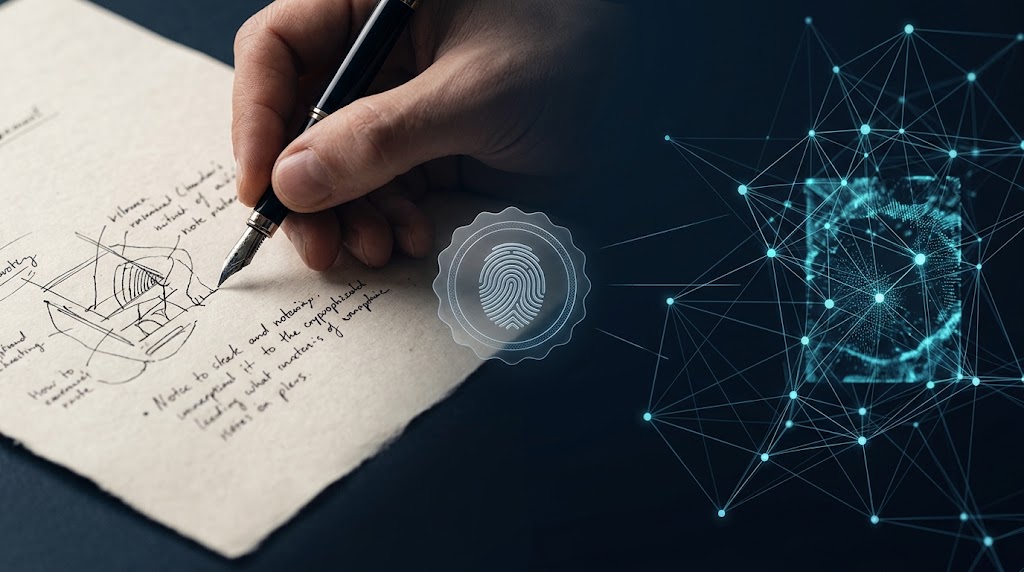
The Verumano protocol, as described in this article, takes a complementary approach. Rather than focusing exclusively on information attached to the final file, it seeks to examine the evidence that helps explain how the work was created.
This approach is intended for illustrators, photographers, writers, musicians, and other independent creators who want to document their work and make their claims more credible.
The principle is to assemble a body of evidence appropriate to the creative discipline. This may include:
- Different project versions and intermediate stages.
- Working files and layers, where available.
- Original RAW files for photography.
- Separate audio tracks and music production sessions.
- Drafts, sketches, notes, and other relevant materials.
- A description of the tools used and any involvement of AI.
These materials do not automatically prove that AI was never involved. They can, however, help a reviewer assess the consistency of the documented process and the strength of the submitted evidence.
Why Include Human Review?
Human review can provide a dimension that cryptography alone cannot: contextual assessment of the submitted evidence.
For example, a reviewer may examine whether the stages of an illustration are consistent, whether the working files correspond to the final artwork, and whether the available documentation provides a credible account of the production process.
This approach still has limitations. Source files may be incomplete, histories may be falsified, and reviewers may make mistakes. AI-assisted work can also be manually refined and accompanied by convincing working files.
The quality of this type of certification therefore depends on public criteria, documented review procedures, reviewer competence, and mechanisms for challenging decisions.
The meaningful promise is not absolute proof of human purity, but a documented and reviewable account of the creative process.
Transparency note: The Verumano-specific mechanisms described in this section reflect the protocol’s stated approach. Their actual availability, certification rules, and security properties should be confirmed through public technical documentation and a verifiable demonstration.
4. SHA-256 Hashes and Dynamic Badges: What Do They Actually Prove?
A certification system combining a cryptographic hash, supporting evidence, and an online status check can be useful. However, each component has a specific role and limitations.
Does a SHA-256 Hash Prove That an Artwork Is Human-Made?
No.
SHA-256 is a cryptographic hash function that calculates a fingerprint from a file’s data. It can be used to compare files: if their hashes differ, their data differ, subject to the algorithm’s security assumptions.
However, a hash does not reveal how a file was produced.
A manually drawn illustration and an AI-generated illustration can both have SHA-256 hashes. The calculation cannot distinguish between their origins.
The hash serves a different purpose: it can link a validation to a specific file. If the file changes, its hash will normally change as well.
For further information, consult the NIST documentation on cryptographic hash functions.
How Could an Online Verification Badge Work?
In the proposed Verumano architecture, a badge could query an API to display the current status of a certification.
A system of this kind could distinguish between several states:
- Certified or validated: The submission has met the stated criteria.
- Suspended or under review: Additional verification is required.
- Revoked: The certification is no longer considered valid by the service.
- Unavailable: The status cannot currently be verified.
A revocation could be reflected in badges that actively query the service. However, a static badge image, screenshot, or offline copy would not automatically update.
Dynamic verification also depends on API availability, service security, and how frequently status checks are performed.
It is therefore more accurate to describe this as an online-verifiable and revocable certification status than as an inviolable architecture.
Why Revocation Alone Cannot Prevent Fraud
Revocation allows a certification to be withdrawn when specified conditions are met. It does not guarantee that every copy of a badge will disappear or that every user will check its current status.
To establish trust, the system needs transparent revocation criteria, an appeal procedure, and clear policies for handling errors, disputes, and technical outages.
Transparent rules matter just as much as the underlying technology.
5. Not By AI vs. C2PA vs. Verumano: Comparing Three Approaches
These three models may complement one another, but their guarantees are not interchangeable.
| Criterion | Not By AI | C2PA | Verumano, as described |
|---|---|---|---|
| Primary purpose | Express a commitment to human creativity | Document digital provenance | Examine evidence of the creative process |
| Type of evidence | Declaration and terms of use | Verifiable manifests and signatures | Source files and human review |
| Role of cryptography | Not central to the badge itself | Central to technical verification | File hashing and a proposed API |
| Independent verification | Depends on the services and procedures offered | Through compatible tools and a trust model | Depends on review procedures and implementation |
| Revocation | Depends on the program’s terms | Signature and trust handling, depending on the circumstances | Revocable status is part of the described approach |
| Main limitation | A commitment alone does not prove origin | Provenance alone does not prove human creation | Evidence and review cannot guarantee absolute certainty |
| Accessibility | Badge availability depends on the program’s terms | Open standard, with varying tools | Requires confirmation of actual availability and conditions |
The open nature of a standard should not be confused with every service built around it being free. Likewise, an open-source project may make code auditing easier, but open-source availability alone does not guarantee reviewer reliability or the truthfulness of a certification.
The comparison should therefore focus on the guarantees actually provided, rather than on the promises being made.
6. Can We Really Prove That a Work Is 100% Human-Made?
This is the central question, and it requires a cautious answer.
None of these three approaches can, on its own, establish with absolute certainty that a work has never benefited from AI assistance.
A version history may be incomplete. Source files can be fabricated or modified. A digital signature may be valid even when it accompanies an inaccurate claim. Human review can increase confidence without eliminating every risk of error or fraud.
Furthermore, the meaning of human creation needs to be defined. A work may have been conceived and composed by a human while relying on proofreading, image editing, or partial generative assistance. Its classification depends on the criteria being applied.
For a label to be meaningful, it must specify what it certifies:
- The absence of AI-generated content.
- A predominantly human-created work.
- A documented and reviewed creative process.
- The integrity of a file since a specified point in time.
- The creator’s declaration concerning the tools used.
These claims are not equivalent.
A credible certification should publish its scope, criteria, evidence requirements, and limitations. It should also explain whether it certifies the absence of AI, a defined level of human involvement, or simply a documented creative process.
7. Toward a Convergence Between Digital Provenance and Human-Creation Certification
The best long-term solution may not be to choose between C2PA and a certification focused on human creative work.
The two approaches could potentially be combined. A protocol that examines the creative process could, for example, associate its review outcome with a signed provenance assertion cryptographically linked to the artwork.
Such an integration could bring together two complementary dimensions:
- Technical evidence: the ability to verify the integrity of information associated with a file.
- Process evidence: the materials examined and the criteria applied during certification.
This convergence would require a clear specification: who signs the assertions, who is responsible for verification, how revocations are published, and how users should interpret the results.
It would also be important to prevent a statement such as “100% human-made” from being automatically treated as true simply because it appears in a cryptographically valid manifest.
Cryptography can make a declaration verifiable and detect certain alterations. It cannot, by itself, turn that declaration into truth.
Conclusion: Trust Is Not Declared. It Is Documented.
In the age of generative AI, protecting human creativity will probably not depend on a single badge or a miracle algorithm.
Self-declared labels can make a commitment visible. C2PA provides a technical framework for documenting and verifying content provenance. An approach such as the one described for Verumano seeks to complement these mechanisms by examining the creative process.
Each method addresses a different need and has its own limitations.
For independent creators, the challenge is to demonstrate how a work was made, preserve supporting evidence, and communicate clearly about any use of AI. For audiences, the challenge is to understand what has actually been verified before deciding whether to trust a claim.
The real value of certification therefore lies not in a promise of absolute inviolability, but in transparent criteria, strong evidence, independent review, and the ability to challenge a decision.
In the age of AI, the best certification will not claim to eliminate all doubt. It will give people the means to understand what has been established, what has merely been declared, and what remains uncertain.
Sources and References
- C2PA — Official Technical Specifications
- C2PA — Principles and Documentation
- Not By AI — Official Website
- Not By AI — The 90% Rule
- NIST — Cryptographic Hash Functions
Editorial note: These sources document the general mechanisms and publicly available rules of the referenced initiatives. Claims about specific Verumano features should be supported by links to its official specification, source-code repository, npm package, and verification service whenever these are available and can be independently checked.