
At the 2022 World Athletics Championships, hurdler Devon Allen ran a reaction time of 0.101 seconds off the blocks in his semifinal. Legal. In the final, he reacted in 0.099 seconds — two-thousandths of a second faster. Disqualified.
Common sense says nobody consciously decides to react two milliseconds faster on purpose. But the rule that ended Allen’s race that night is stricter than common sense: in competitive sprinting, reacting too fast is treated the same as cheating. That single rule — and the debate over whether it’s even set at the right number — is also the best explanation for why most online reaction time tests are measuring something other than what they claim to.
Table of Contents
The rule that ended Devon Allen’s race
World Athletics’ technical rules set the false-start threshold at exactly 100 milliseconds: any sprinter whose starting blocks register a reaction faster than that is disqualified automatically, no review, no appeal. [1] The justification is a claim about human biology, not fairness in the abstract — officials argue that no one can hear a gunshot, process it, and physically respond in under a tenth of a second, so anything faster must be a guess timed to the starter’s rhythm rather than a genuine reaction. [3]
Allen’s case became a flashpoint precisely because the margin was so absurd: 101 milliseconds was a legitimately fast, legal start; 99 milliseconds, by the same athlete in the same event days later, was an automatic disqualification. [3] It’s the same debate, at much lower stakes, that plays out every time someone screenshots a 0.089-second result from an online reaction test and gets asked, only half-joking, whether they cheated.
Is 100 milliseconds even the right number?
It’s also not obviously the correct cutoff. A 2017 study in the Journal of Sports Sciences analyzed every World and European Championship reaction-time dataset from 1999 to 2014 and modeled the actual distribution of legitimate elite sprinter reactions. [2] The authors found that the real minimum-reaction threshold was closer to 115 milliseconds for men and 119 milliseconds for women — meaning the current 100ms rule likely lets some genuine false starts through as “legal,” while occasionally catching an athlete’s authentic fast reaction on the wrong side of an arbitrary line. [2]
That’s a fixable-sounding problem: move the number. But it doesn’t address the more interesting flaw underneath it.
The real problem isn’t the threshold — it’s predictability
University of Toronto statistics professor Jeffrey Rosenthal made the sharper argument after Allen’s disqualification: the issue was never really where the cutoff sits, but that a human-fired starter’s gun has a rhythm to it. [4] Elite sprinters spend years training their start, and part of that training is getting a feel for how long the “set” position typically holds before the gun goes off. A reaction that looks impossibly fast might not be anticipation of a random event — it might be a well-calibrated guess about a semi-predictable one.
Rosenthal’s proposed fix is elegantly simple: make the delay before the starting signal genuinely unpredictable — long enough, and random enough, that no amount of training lets an athlete time it — and then let them react as fast as their nervous system allows, with no arbitrary millisecond cutoff at all. [4] Remove the ability to predict, and you don’t need a penalty for guessing, because guessing stops working.
Why Holeshot is built around a random delay
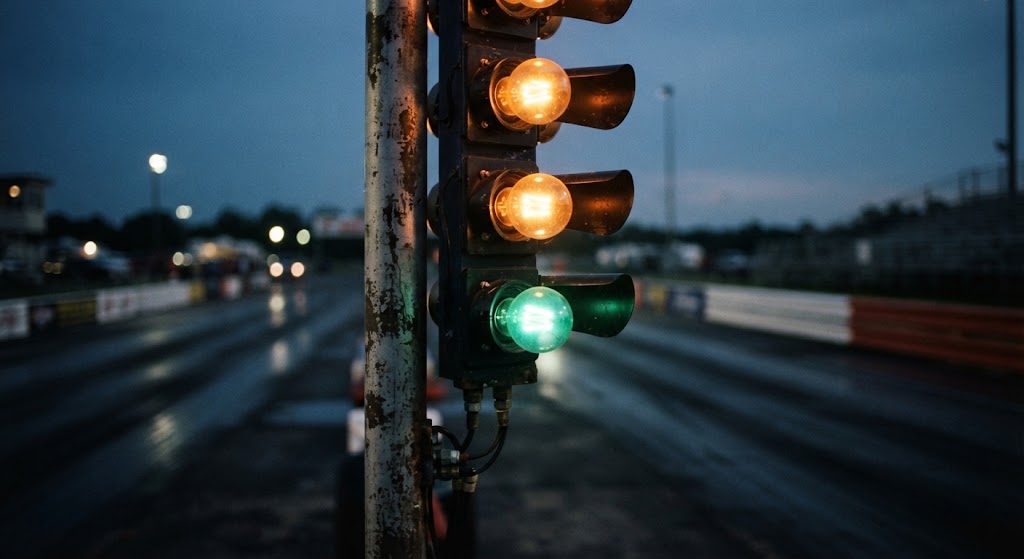
This is, not coincidentally, exactly how a drag-strip “Christmas tree” start already works, and exactly how we built Holeshot. Three amber lights fire in sequence, half a second apart — then an unpredictable delay of one to several seconds before green. You can’t learn the rhythm, because there isn’t one to learn.
Most browser-based reaction tests skip this entirely. A screen turns from red to green after a fixed or narrowly randomized delay, with no penalty at all for clicking early — so the “best time” people brag about is frequently a well-timed guess, not a genuine reaction, exactly the confound Rosenthal was describing in elite sprinting. Holeshot treats an early click the way a real starting system does: as a foul, a red light, recorded separately and excluded from your average. It’s a small design choice with a direct line back to a real, ongoing debate in sports science about what a “reaction time” measurement is actually allowed to mean.
What this means for your own reaction time score
If you’ve taken a reaction time test before and landed a suspiciously fast number — sub-150 milliseconds, especially sub-100 — the honest interpretation isn’t “elite reflexes.” It’s the same interpretation World Athletics reaches for a 99-millisecond block start: probably a guess, not a reaction. A test with no false-start detection has no way to tell the two apart, which means every score it reports is quietly contaminated by however good you got at guessing the rhythm of that particular screen.
A five-run average with visible red lights mixed in isn’t a worse result than a clean streak of suspiciously fast numbers — it’s a more honest one.
Take the test yourself →
Watch the tree, go on green, and see how many red lights you actually catch.
About this article
Written and maintained by the Holeshot editorial team at Loch Ness Paris.
This piece summarizes public reporting and peer-reviewed sports-science research (see Sources below);
it is not itself original research and Holeshot is not a clinical or diagnostic tool.
Have a correction or a source we should add? Contact us.
[Optionally replace this box with a named subject-matter reviewer, their credentials, and a photo/bio link —
a real reviewer credit strengthens E-E-A-T more than an editorial-team byline.]
Sources & further reading
- World Athletics. (2003). The New False Start Rule. https://worldathletics.org/news/news/the-new-false-start-rule
- Brosnan, K. C., Hayes, K., & Harrison, A. J. (2017). Effects of false-start disqualification rules on response-times of elite-standard sprinters. Journal of Sports Sciences, 35(10), 929–935. https://doi.org/10.1080/02640414.2016.1201213
- Campbell, M. (2022). Time has come for World Athletics to budge from its outmoded policy on false starts. CBC Sports. https://www.cbc.ca/1.6527053
- Rosenthal, J. S. (2021). False Start? False Rule! Toronto Star / probability.ca. https://probability.ca/jeff/writing/FalseStart.txt