
Table of Contents
- Where this fits: vertical versus horizontal control
- An eye for an eye — except it isn’t equal
- A law handed down from heaven
- Three classes, written into the law itself
- The contrast that makes this useful
- Sources
Where this fits: vertical versus horizontal control
A companion piece on this site examines the evil eye as a system of social vigilance — an informal, horizontal mechanism in which ordinary people police each other’s envy and success, with no author, no institution, and no written rule behind it. This article looks at the opposite end of the same spectrum: a documented historical case where social stratification wasn’t whispered between neighbors, but carved in stone, stamped with divine authority, and enforced by the state. That case is the Code of Hammurabi, promulgated in Babylon around 1754 BCE — one of the oldest and most complete written legal codes in existence.
The comparison isn’t a claim that one caused the other, or that Hammurabi’s Babylon had any documented evil eye tradition specifically. It’s narrower and more useful than that: both cases show the same underlying social pattern — a stratified, unequal order sustaining itself — expressed through two entirely different mechanisms, one informal and diffuse, the other explicit and codified.
An eye for an eye — except it isn’t equal
The code’s most famous line is built, fittingly, around an eye. Law 196 states: “If a man destroy the eye of another man, they shall destroy his eye” — the original lex talionis, an eye for an eye. Read in isolation, it sounds like a principle of strict equality before the law: whatever harm you cause, the same harm is done to you in return, regardless of who you are.
It isn’t equal at all. The clauses immediately following fix a price scale by social class. Destroying the eye of an amelu — a free man of the elite class — could be settled with a payment of one gold mina. Destroying the eye of a wardum, a slave, cost the offender only half that price. The same injury, the same organ, priced differently depending on whose body it happened to. A principle presented as universal justice turns out, on inspection, to be calibrated by hierarchy from the outset.
A law handed down from heaven
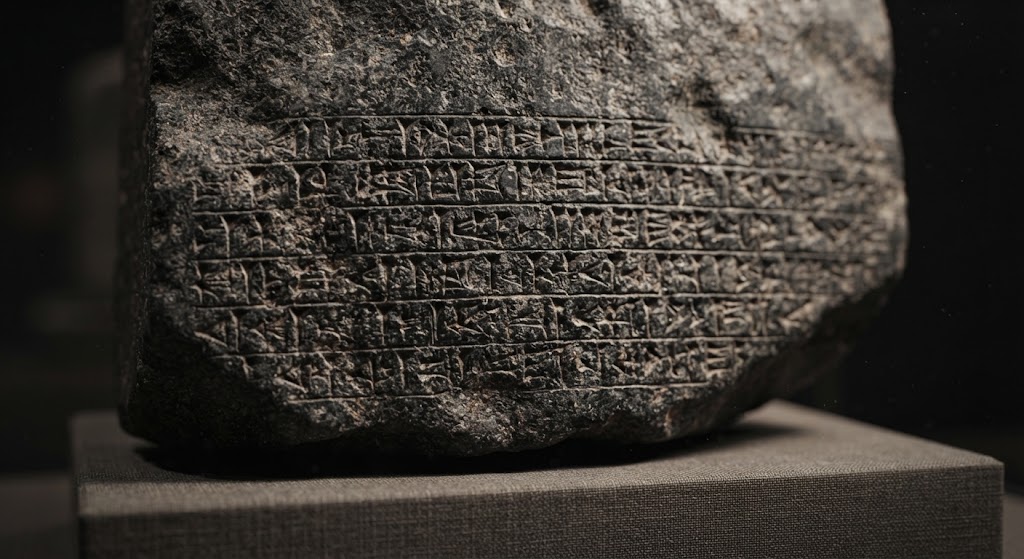
The code’s authority was never framed as Hammurabi’s alone. The stele on which the laws were carved depicts him receiving them directly from Shamash, the Babylonian sun god, and the prologue states explicitly that the gods appointed him “to prevent the strong from oppressing the weak.” This is worth sitting with rather than skimming past: a legal system that assigns different values to different classes of person announces itself, in its own founding text, as protection for the vulnerable, sanctioned by heaven itself.
That is not a hidden or inferred mechanism requiring careful reading between the lines — it’s the plain, stated logic of the document. An unequal order gains part of its stability by being presented, credibly and publicly, as just. Later social theorists — Marx, and more specifically Antonio Gramsci’s concept of hegemony — would describe this general pattern in religion and ideology broadly: domination that doesn’t require constant force because it has secured belief in its own legitimacy. Hammurabi’s stele is, in effect, that mechanism caught in the act, nearly 3,800 years before anyone had a name for it.
Three classes, written into the law itself
Babylonian society under the code was formally divided into three tiers: the amelu, an elite class with full civil rights whose birth, marriage, and death were officially recorded; the mushkenu, free but likely landless commoners; and the wardum, the enslaved. Roughly 282 laws in total governed contracts, property, marriage, and personal injury — nearly half concerned with contracts alone — and penalties throughout the code varied systematically according to which of these three tiers the offender and the victim belonged to.
This detail matters beyond antiquarian interest. It means the code isn’t merely a historical curiosity about ancient punishment — it’s a rare surviving instance where a society’s stratification is not something historians have to reconstruct from indirect evidence, but something the society wrote down, explicitly, as law.
The contrast that makes this useful
Set beside the evil eye, the difference in mechanism is stark. Hammurabi’s Code is vertical and overt: a written, state-issued, divinely-stamped document, openly encoding hierarchy, enforced by judges and officials, and available for anyone to read carved into stone in the public square. The evil eye, by contrast, is horizontal and informal: no author, no text, no institution — enforced by nothing more than a glance, a rumor, and a bead worn around the neck.
What connects them is not causation but function. Both, in their very different registers, correlate with — and plausibly help sustain — the same kind of stratified society: one by codifying inequality from above and calling it justice, the other by keeping ordinary people’s suspicion pointed sideways, at each other, rather than upward, at the structure itself.
Sources
- Analysis: Code of Hammurabi — EBSCO Research Starters
- Promulgation of Hammurabi’s Code — EBSCO Research Starters
- The Code of Hammurabi — Lumen Learning, World History
Related: The Evil Eye as Social Vigilance, on the horizontal, informal counterpart to the mechanism described here, and Eclipses, the Eye of Horus, and the Evil Eye, on where the eye symbol itself comes from.