
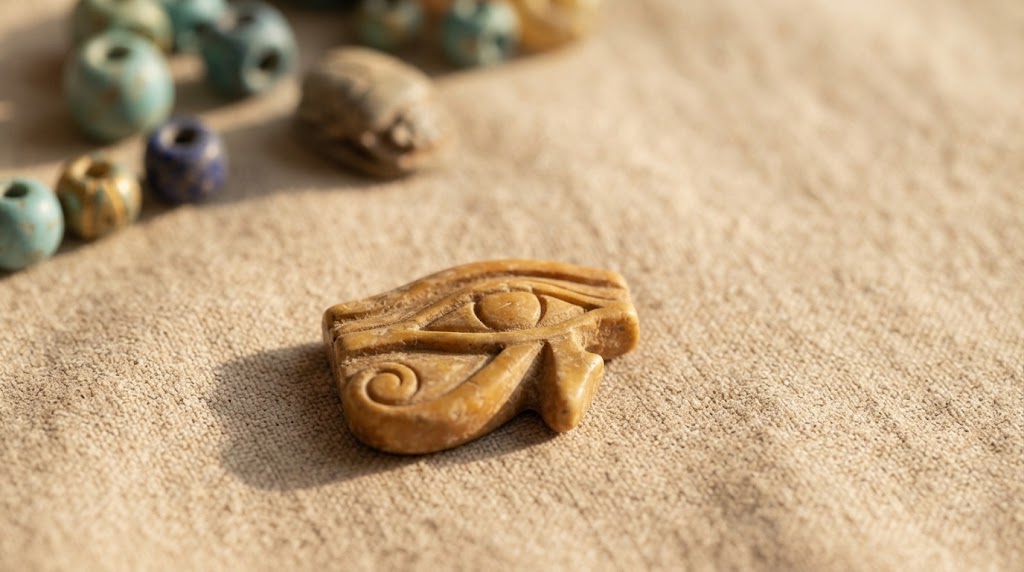
Third in our evil eye symbols series: the stylized Egyptian eye that shows up constantly in jewelry, almost always labeled “Eye of Horus” — even when the piece being described is closer to something else entirely. The two eyes look nearly identical. They are not the same symbol.
One shape, two different eyes
Ancient Egyptians used a single stylized shape — a human eye marked with the facial lines of a falcon, known as the wedjat — to represent two different mythological eyes at once. The left wedjat eye was called the Eye of Horus. The right was the Eye of Ra. Visually, jewelry and modern reproductions rarely bother distinguishing left from right, which is exactly how the two get flattened into one generic “Egyptian eye” symbol online.
Horus: the eye that heals
The Eye of Horus comes from the myth of Horus’s battle with his rival Set, who tore out or destroyed the eye during their conflict. The god Thoth restored it, and Horus later offered the healed eye to his father Osiris, whose afterlife it sustained. That origin story is why the Eye of Horus is tied specifically to healing, restoration, and protection — it’s an eye that was broken and made whole again, which is the whole point of wearing it.
Ra: the eye that fights back
The Eye of Ra tells a different kind of story. Rather than a wound to be healed, it functions as an extension of the sun god Ra’s own power — frequently personified as an independent, fiercely protective goddess (identified at different times with Sekhmet, Hathor, Bastet, and others) who defends Ra against the forces of chaos. Where the Eye of Horus is a shield, the Eye of Ra is closer to a weapon: violent, active, and often represented by a lioness or the rearing cobra (uraeus) worn on royal crowns.
Even the experts don’t fully agree. Egyptologist Richard H. Wilkinson argues the two eyes gradually became distinguished as the lunar Eye of Horus and solar Eye of Ra over time. Rolf Krauss disputes this, arguing no surviving text actually equates either eye with the sun or moon until quite late in Egyptian history — meaning the original distinction may have meant something else entirely. Worth knowing before anyone states either version as settled fact.
Why the mix-up happens so often
Because both eyes share the same wedjat shape and the same falcon markings, distinguishing them requires knowing which eye (left or right) a specific piece depicts and what story the seller is actually invoking — details most product listings skip entirely, defaulting to “Eye of Horus” as a catch-all because it’s the more widely recognized name. A pendant genuinely referencing solar power, royal authority, or a fierce protective goddess is arguably wearing the wrong label if it’s called an Eye of Horus by default.
Not the same family as the Nazar or Hamsa
Despite showing up on the same “evil eye” lists, the wedjat eye comes from an entirely separate mythological tradition than the Turkish Nazar or the eye set into a Hamsa hand. They’re grouped together today because they share a protective function and a similar “watching eye” visual language — not because they share an origin.
Sources
1. Wikipedia — Eye of Horus — en.wikipedia.org
2. Wikipedia — Eye of Ra, citing Wilkinson and Krauss — en.wikipedia.org
Part of Discover the Symbols of the World — see the full list in 7 Evil Eye Symbols and How They Protect You.