
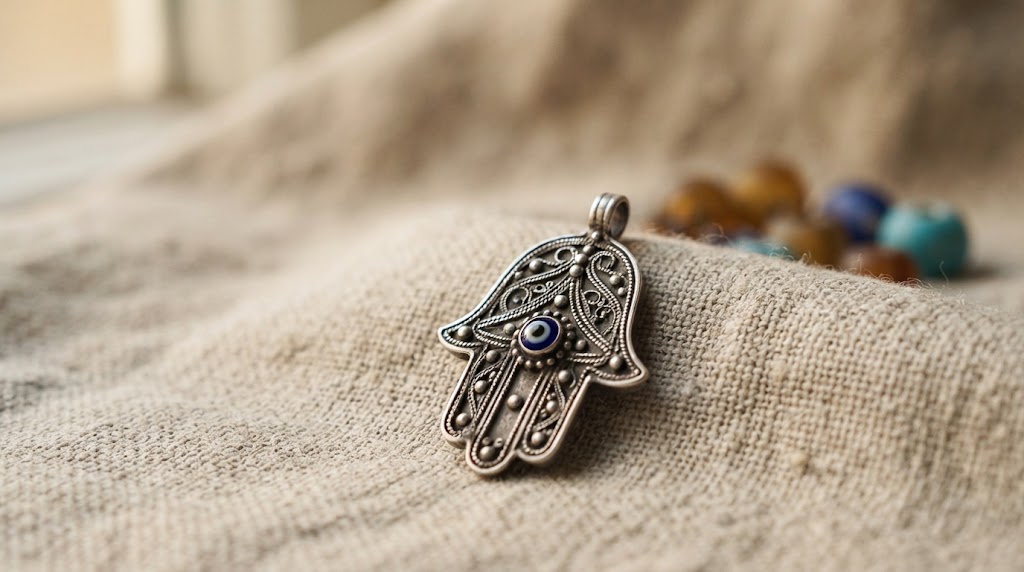
Second on our list of seven evil eye symbols, the Hamsa is one of the most recognizable protective hands in the world — and one of the few symbols where even the reference sources admit they don’t fully agree on where it came from, or which way up you’re supposed to wear it.
Nobody actually knows where it started
Most Hamsa content online picks one origin story and states it as fact. The honest picture is messier. One line of scholarship connects the Hamsa to ancient Carthage and Phoenicia, where the hand (in some depictions, the vulva) of the goddess Tanit was used to ward off the evil eye. A separate theory ties it to an Egyptian amulet called the “Two Fingers,” representing Isis and Osiris with the thumb standing in for their child, Horus — invoked to protect children specifically. A third reading layers Horus back into the symbol a different way: the eye at the Hamsa’s center is sometimes interpreted as a reference to the Eye of Horus itself, representing the inescapable “eye of conscience.” Reference sources are explicit that the exact meaning “remains debated” — which is a more honest starting point than picking whichever story sounds best for a product description.
Fatima’s hand, Miriam’s hand, or nobody’s in particular
The two names attached most often — Hand of Fatima (Islamic tradition, referencing the Prophet Muhammad’s daughter) and Hand of Miriam (Jewish tradition, referencing Moses’s sister) — aren’t two names for the same original story. They’re two separate cultural claims layered onto the same open-hand shape, each rooted in its own religious context. Worn today, the Hamsa is frequently used by people outside either tradition entirely, as a general symbol of protection and blessing rather than a specific religious object — worth being clear about, rather than assuming a buyer’s tradition for them.
In practice. If you’re gifting a Hamsa to someone specifically for its Jewish or Islamic significance, it’s worth saying so explicitly rather than leaving it as generic “protection jewelry” — the two traditions aren’t interchangeable, even though the shape is shared.
The orientation question
Ask five people whether a Hamsa should point up or down and you’ll likely get five confident, contradictory answers. Fingers pointing up is commonly described as inviting in blessings, good fortune, and positive energy. Fingers pointing down is commonly described as actively deflecting negative energy and evil intent away from the wearer. Both explanations circulate widely and confidently — which is itself the tell that there isn’t a single settled rule here, only regional and personal convention. Rather than presenting one direction as “correct,” the more accurate statement is that orientation carries different popular meanings depending on who you ask, and wearing it either way is equally valid.
Not the same eye as its neighbors
The eye often set into the palm of a Hamsa looks related to the Nazar bead, but the two developed along different lines — the Nazar as a standalone glass amulet, the Hamsa as a hand-shaped amulet that later incorporated an eye motif. Treat them as related neighbors in the same protective family, not two versions of the same object.
Sources
1. Wikipedia — Hamsa, citing Lemaire (1977) and Barbatti — en.wikipedia.org
2. Encyclopaedia Britannica — Evil eye — britannica.com
Part of Discover the Symbols of the World — see the full list in 7 Evil Eye Symbols and How They Protect You.