
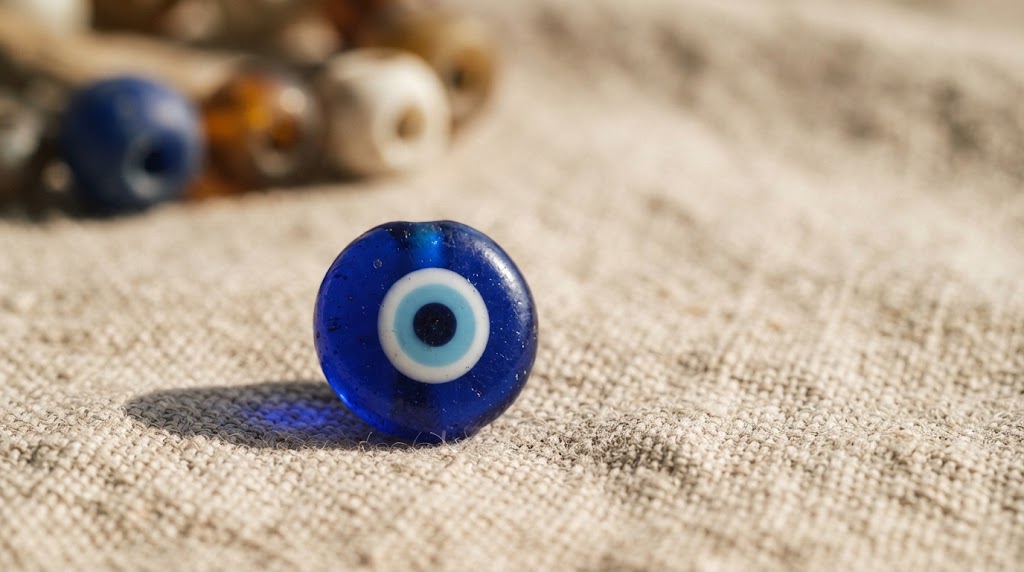
Of the seven evil eye symbols worn around the world, the Nazar is the one people picture first: a deep blue, teardrop-shaped bead with concentric white and blue rings around a dark center. It’s also the one whose story gets flattened the most — reduced to “ancient Turkish good luck charm” without much else. Here’s what actually holds up about the bead itself. For the belief behind it, and why it is a protection charm rather than a luck charm, see our guide to the evil eye meaning.
Older than “ancient” usually means
It’s tempting to attach the Nazar to a specific empire — Ottoman, Byzantine, take your pick — because it makes for a tidier story. The reality is older and messier. Glass eye beads used as protective amulets appear across the Mediterranean and Near East as far back as the 16th century BCE, made and traded from Mesopotamia to Egypt to the Aegean, roughly three thousand years before the Ottoman Empire existed. The belief the Nazar responds to — that an envious or admiring glance can transmit harm — is documented across dozens of unconnected ancient cultures, which suggests it’s less a single tradition passed down a single line, and more a pattern humans kept arriving at independently.
Why blue, specifically
The color isn’t decorative. In regions where dark eyes were overwhelmingly the norm, a pale or blue-eyed gaze stood out — rare enough to be seen as unusual, and unusual enough to be treated as potentially dangerous. The Nazar’s blue center is generally understood as a kind of visual decoy: an eye striking enough to catch the harmful glance and hold it, rather than let it pass through to the person wearing the bead.
Absorb, not reflect
One detail worth getting right: the Nazar isn’t usually described as a mirror bouncing the harmful gaze back at whoever cast it. The more accurate framing, consistent across reference sources, is that it absorbs or shields against the negative glare — taking the hit so the wearer doesn’t have to, rather than deflecting it elsewhere. It’s a small distinction, but it changes the mental image from “weapon” to “shield,” which is closer to how the belief actually works.
Related. We got this exact detail wrong on our own product description once — see Verified or Vibes: The Turkish Evil Eye Cuff for the full correction.
Not the same eye as its neighbors
The Nazar sits in a family of related but distinct eye symbols. The Greek mati looks nearly identical and is closely related historically, but carries its own regional rituals (like xematiasma, a removal ritual performed by family elders) that the Turkish tradition doesn’t share in the same form. The eye at the center of the Hamsa hand is a different design lineage entirely, tied to hand-shaped amulets rather than standalone eye beads. And the Egyptian Eye of Horus, despite superficial resemblance, comes from an unrelated mythology — a healed eye from a god’s battle wound, not a decoy for envious glances. Worth knowing if you’re choosing between them for what they actually represent, rather than picking whichever “evil eye” charm is closest at hand.
Wearing one today
Most people who wear a Nazar today aren’t performing a specific ritual — they’re carrying a small, deliberate piece of a very old idea: that attention, even well-meaning attention, can weigh on a person, and that it’s reasonable to want something watching your back. Just don’t expect it to bring luck: in the tradition, the nazar protects, it doesn’t attract fortune. If that resonates, we have a Nazar cuff bracelet — audited, corrections and all, in the Verified or Vibes post linked above.
Sources
- Wikipedia — Nazar (amulet), citing Kaya, Singh & Dua, British Journal of Ophthalmology (2009) — en.wikipedia.org
- Encyclopaedia Britannica — Evil eye — britannica.com
- Made in Turkey Tours — History and meaning of the Turkish evil eye
- Memphis Tours — The nazar amulet (etymology, Nazarköy)
Part of Discover the Symbols of the World — see the full list in 7 Evil Eye Symbols and How They Protect You.
Updated September 27, 2026: clarified that the nazar is a protection charm, and added two sources.